
Data Center Watch examined 74 selected candidates across the 36 state gubernatorial races in the 2026 midterms, analyzing their publicly documented positions on data center development.
Key Takeaways
43% of gubernatorial candidates support a ban or moratorium on data center development, while another 51% support regulation or conditional development.
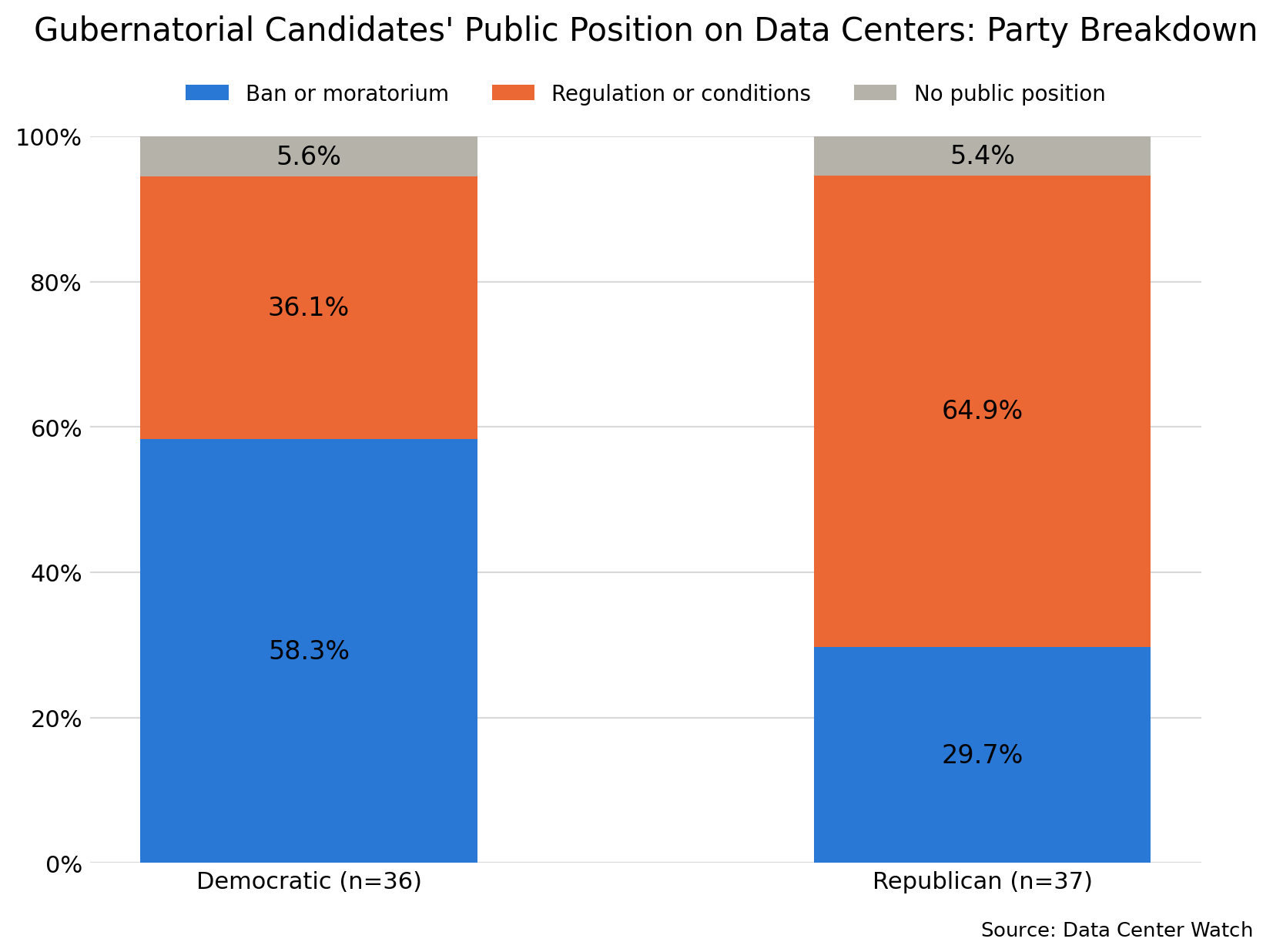
Support for bans or moratoria crosses party lines, although it is more prevalent among Democrats (60%) than Republicans (30%).
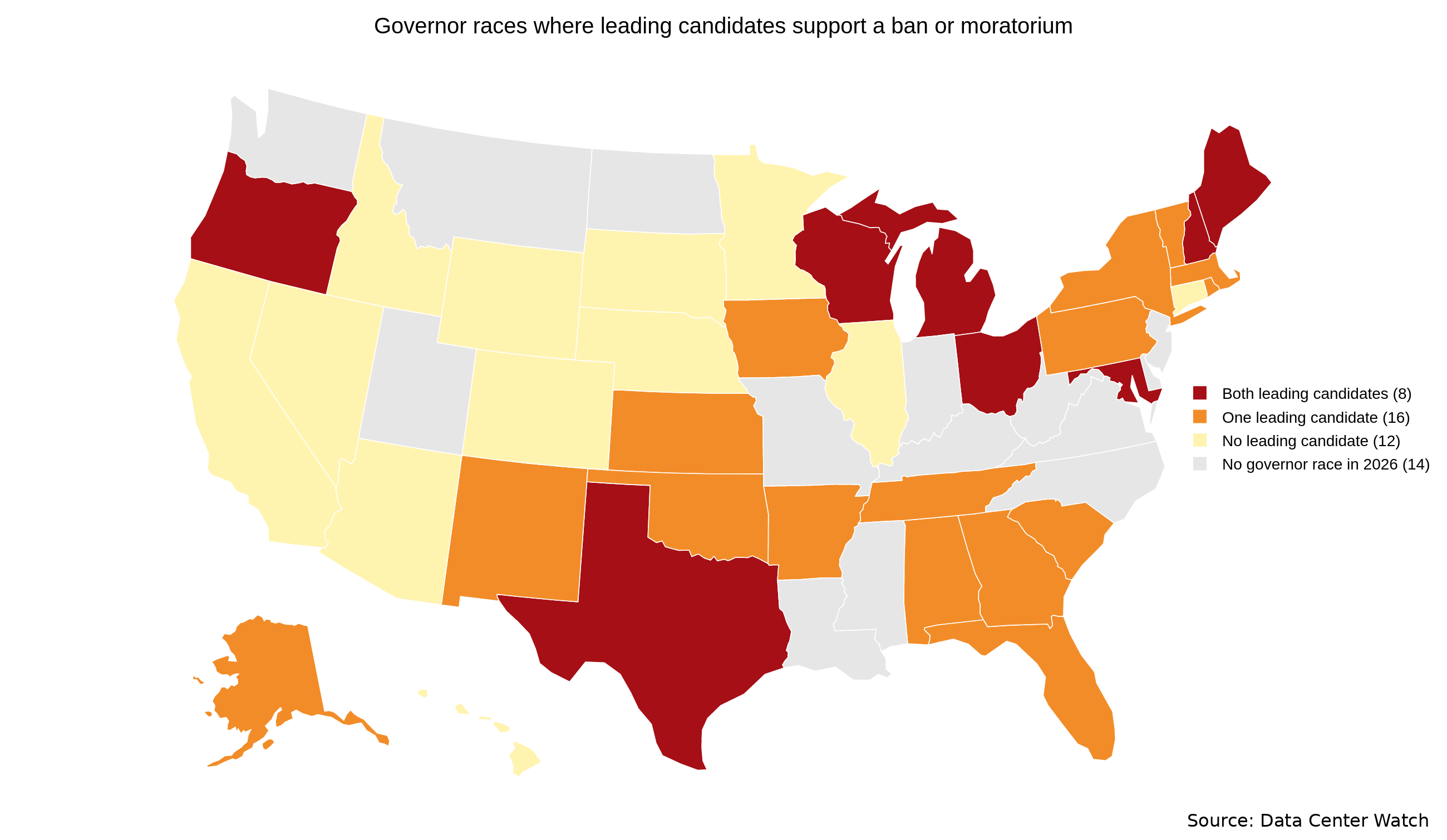
In eight states, both leading major-party candidates support some form of ban or moratorium, demonstrating how restrictions have become a bipartisan issue in gubernatorial campaigns.
From local opposition to state politics
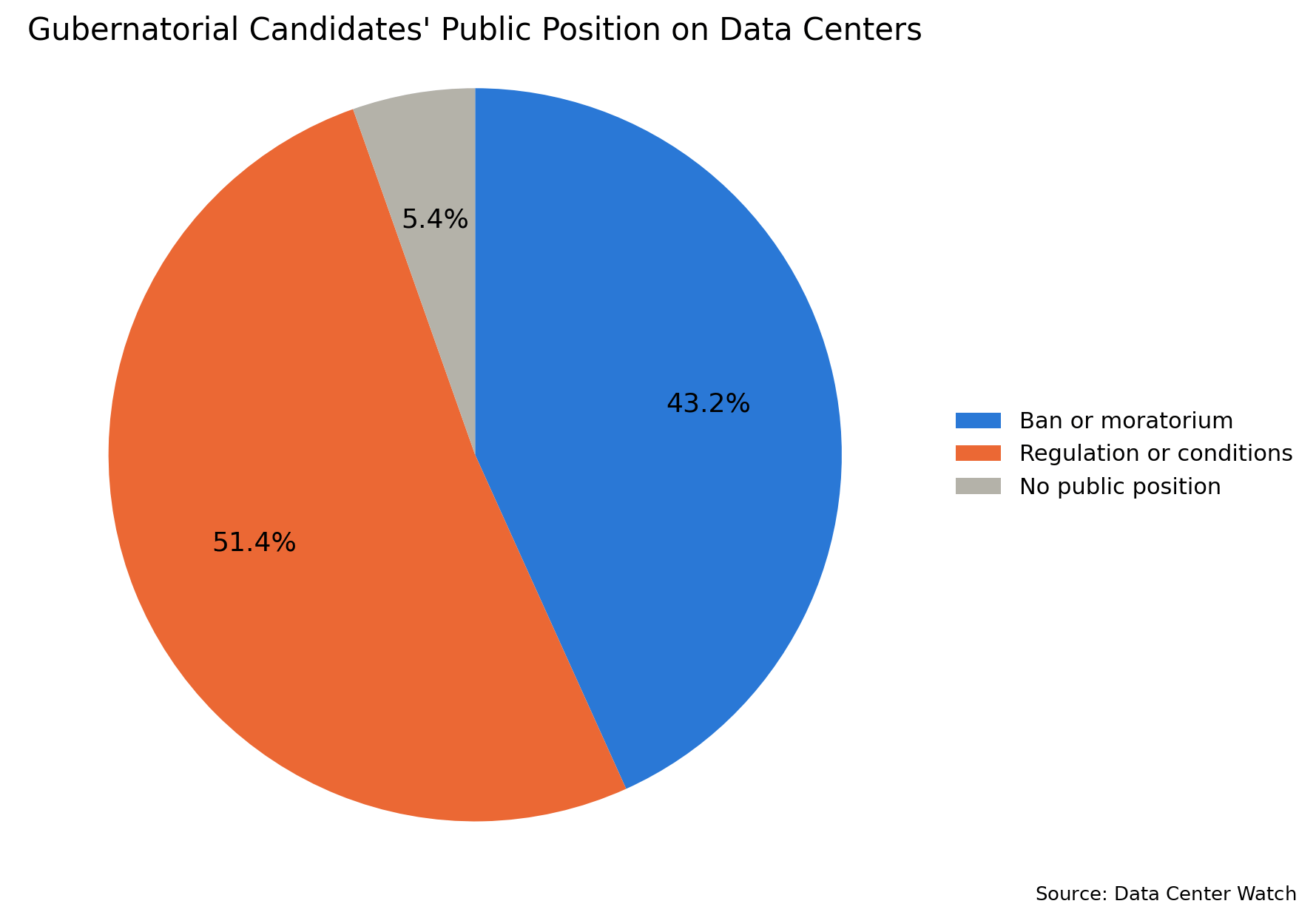
Of the 74 candidates, 94% had documented positions supporting either regulation, conditional development, bans, or moratoria. Within the group of candidates, 43% supported a ban or moratorium, while 51% supported regulation or conditional development. Only 5% had no publicly known position. We classified candidates supporting multiple measures by the most restrictive position they publicly endorsed. The moratorium category includes candidates calling for temporary development pauses and targeted construction prohibitions, not necessarily opposition to all data center construction.
Gubernatorial candidates have presented more restrictive positions than congressional candidates. Unlike congressional candidates, governors directly control certain state regulatory and permitting processes, making their positions particularly relevant to the industry’s development pipeline.
Party breakdown
Regulatory scrutiny of data centers is not confined to one party. While both parties show substantial support for restrictions on data center development, Democratic gubernatorial candidates more frequently support bans or moratoria.
Among the Democrats tracked, 58% supported bans or moratoria, compared with 36.1% supporting regulation or conditional development.
Among Republican candidates, 30% supported bans or moratoria, while 64.9% supported regulation or conditional development.
Key gubernatorial races
In 24 of the 36 gubernatorial races, at least one candidate supports a ban or moratorium on data center development.
In eight states — Maryland, Maine, Michigan, New Hampshire, Ohio, Oregon, Texas, and Wisconsin — both leading major-party candidates have supported some form of ban, targeted construction restriction, or development pause.
In 16 states, one selected candidate supports a ban or moratorium, while in 12 states neither candidate has commented publicly on data center development.
Texas: Gina Hinojosa (D) vs. Greg Abbott (R)
Texas offers one of the clearest examples of data center regulation becoming an election issue. Governor Greg Abbott has already directed state agencies to halt certain data center permits and approvals pending electricity grid and water-use audits. It remains to be seen, however, whether this was a pre-electoral tactical move or a strategic shift that would partially define Abbott’s second term in a state that has historically welcomed development. His Democratic challenger, Gina Hinojosa, has called for an immediate moratorium until the legislature establishes stronger protections for communities and reforms data center tax incentives.
Oregon: Tina Kotek (D) vs. Christine Drazan (R)
Democratic Governor Tina Kotek has paused certain state-land transactions and environmental permits for new or expanding data centers, with restrictions extending through July 2027. Republican challenger Christine Drazan has also called for an immediate statewide moratorium, marking a shift from her earlier emphasis on maintaining development incentives. The measures have raised concerns in industry, with Amazon and rural community leaders warning of potential impacts on planned investment and jobs.
Ohio: Amy Acton (D) vs. Vivek Ramaswamy (R)
Both candidates have proposed restrictions on future data center development. Democrat Amy Acton supports a conditional moratorium requiring developers to cover utility costs, meet environmental standards, and provide community and labor benefits. Republican Vivek Ramaswamy has pledged to halt new state approvals on his first day in office until comprehensive legislation is enacted, including requirements on electricity costs, property taxes, and environmental protection. Ohio’s current governor, Mike DeWine, has already paused consideration of new data center tax exemptions, although that measure does not prohibit construction of approved projects.
Michigan: Jocelyn Benson (D) vs. John James (R)
Local development concerns are part of the gubernatorial debate, crossing party lines in Michigan. Both leading candidates support temporary restrictions on new data centers. Democrat Jocelyn Benson has called for a moratorium until enforceable safeguards address electricity costs, water use, transparency, and community participation. Republican John James has proposed a five-point moratorium framework addressing local control, utility costs, water, pollution, and agricultural land preservation.
New Mexico: Deb Haaland (D) vs. Gregg Hull (R)
New Mexico presents a different political divide. Democrat Deb Haaland has pledged to impose an immediate moratorium on new large-scale data centers until stronger safeguards are established. Republican Gregg Hull opposes a statewide pause, favoring project-by-project reviews and local control over development decisions. Given the opposition campaign surrounding Project Jupiter, the Oracle-backed data center campus in Santa Teresa, the next governor could influence the regulatory oversight of its supporting energy infrastructure, which continues to face permitting challenges.
Gubernatorial elections carry direct regulatory implications for data center development. State-level policies govern electricity costs, grid infrastructure, water use, permitting, and local control, frequently superseding local decision-making authorities. Texas and Oregon demonstrate how executive action can already affect data center development, while Michigan, Ohio, and New Mexico show the different approaches candidates are proposing ahead of the election.
What’s next?
This analysis offers an early look at Data Center Watch’s expanding research into the political landscape surrounding data center development ahead of the 2026 midterms.
Following Election Day, Data Center Watch will release a comprehensive post-election report examining congressional and gubernatorial election results, key state legislative and local races, and ballot measures addressing data center development.
The report will assess how these outcomes could shape future regulation, permitting, and investment risks for the industry.
The full post-election report will be available for purchase. Please reach out if you're interested in obtaining a copy.
Your research shows that data center restrictions are becoming a bipartisan political issue. But the next challenge is turning campaign promises into measurable public protections.
A moratorium can delay construction. It cannot, by itself, demonstrate that the next project will serve the public interest.
Before approving major data centers, authorities should be able to answer five questions:
Who pays for grid upgrades? How much water will be consumed? How much electricity capacity will actually be used? What economic benefits will remain in the community? And which alternatives were considered?
These questions require independently verifiable evidence, not just developer forecasts or political commitments.
The real test comes after the election: can elected officials demonstrate that their decisions protect communities while allowing economically justified investment?
Would Data Center Watch consider tracking these measurable outcomes alongside moratoriums and regulatory commitments?
94% of the 74 candidates backing some limit, and 43% backing a ban or moratorium, means the new governors choose the form of the restriction. A condition costs a developer money and a pause costs it time, and on a construction loan time is interest accruing before any rent starts. Stateline counted 33 local restriction measures passed or leading by Tuesday night against 1 in favor. In your 8 both-pause states, does the winner's version set a size threshold?