
Briefing 12/19/2025
Weekly updates on the political risks American data center projects
Happy Holidays!
This week’s round-up: In Maine, Lewiston’s City Council unanimously rejected a proposed $300 million AI data center after residents rapidly mobilized against the project. In Michigan, state energy regulators conditionally approved DTE Energy’s special power contracts for the Saline Township data center. And in Michigan’s Green Charter Township, local officials adopted a one-year moratorium on all data center development to pause new proposals while the planning commission drafts a new local ordinance.
Lewiston, Maine, votes down $300M AI data center after local backlash
Lewiston’s City Council voted unanimously to reject a proposal to build an AI data center inside the historic Bates Mill No. 3 after residents packed the meeting and raised concerns about environmental/health impacts, utility costs, and the project’s local value proposition. Local opposition mobilized quickly among residents, including students, and through online organizing and social media, with protesters showing up at City Hall.
Why it matters:
Local process risk can compress timelines: the proposal went public and triggered decisive political pushback within days, showing how fast community sentiment can harden and flip votes.
Incentives focus: reporting highlighted concerns over a proposed long-term tax arrangement (TIF/credit enhancement), reinforcing that fiscal terms can amplify opposition and raise approval risk.
Michigan Regulators Approve Power Contracts for Saline Township Data Center, Triggering Backlash
The Michigan Public Service Commission (MPSC) unanimously approved two special power supply contracts between DTE Energy and Green Chile Ventures, a subsidiary of Oracle Corp., enabling the project to move forward from an energy-regulatory standpoint.
The approvals included conditions designed to allocate costs associated with serving the data center to the customer rather than to other ratepayers, as well as provisions allowing for reduced power delivery during periods of system constraint.
Project opponents expressed concerns regarding the expedited ex parte review process, the extent of contract redactions, and the scale of the project’s anticipated electricity demand.
Why it matters:
Utility commissions new battlegrounds: Even when data center projects clear political hurdles, utility regulators are increasingly becoming a secondary venue where community opposition re-emerges. In response, commissions are applying project-specific conditions on cost allocation, service conditions, and future tariff design, with potential implications for project timelines and operating economics.
Transparency narratives: The use of an ex parte approval process for a large-load data center has drawn criticism from some elected officials, advocacy groups, and local opposition, who have incorporated in their narrative questions about public participation, disclosure, and the appropriate review framework for future large customers.
Green Charter Township adopts one-year moratorium to stop data centers while it drafts a local ordinance
Green Charter Township’s Board of Trustees adopted a resolution imposing a one-year moratorium on the permitting, review, approval, location, construction, and installation of any data center facilities. Township leaders framed it as an immediate “pause” to allow due diligence, with the planning/zoning commission tasked to research data center impacts and draft an ordinance.
The resolution cited concerns about water and energy consumption and noise, and said the township is concerned that—without regulations—data centers could be established in inappropriate or inadvisable locations. The supervisor suggested he’d like a draft ordinance back within six months, even though the moratorium runs a year and can be extended or revoked once an ordinance is adopted.
Why it matters:
Moratoria can come before projects. Even without an active application, officials can pause all data centers, creating timeline uncertainty and raising the bar for early local outreach.
The real fight shifts to writing the rules. Once a township starts drafting an ordinance (water, power, noise, siting), the risk moves from one vote to a longer political process that can tighten standards and reduce where projects can go.
Mentions in the Press
Data Centers Are Booming. So Is a Backlash Over Electricity Rates
https://www.investors.com/news/data-centers-boom-backlash-electricity-rates-google-meta-amazon-microsoft/
Communities Are Rising Up Against Data Centers — and Winning
https://www.theverge.com/science/841169/ai-data-center-opposition theverge.com
As data center backlash grows across the country, Change.org sees a surge of petitions in 2025
https://www.fastcompany.com/91460617/data-center-backlash-wave-of-change-org-petitions-in-2025
Calls for US Data Center Freeze Grow as Local Enthusiasm Melts
https://www.datacenterknowledge.com/build-design/calls-for-us-data-center-freeze-grow-as-local-enthusiasm-melts
Lewiston made the right call on AI data center https://www.centralmaine.com/2025/12/18/lewiston-made-the-right-call-on-ai-data-center-letter/
Democratic senators investigate data centers’ effects on electricity prices
https://www.theguardian.com/us-news/2025/dec/16/data-centers-consumer-prices
Why Elon Musk Is Suddenly Talking So Much About Space Data Centers
https://www.theinformation.com/articles/elon-musk-suddenly-talking-space-data-centers
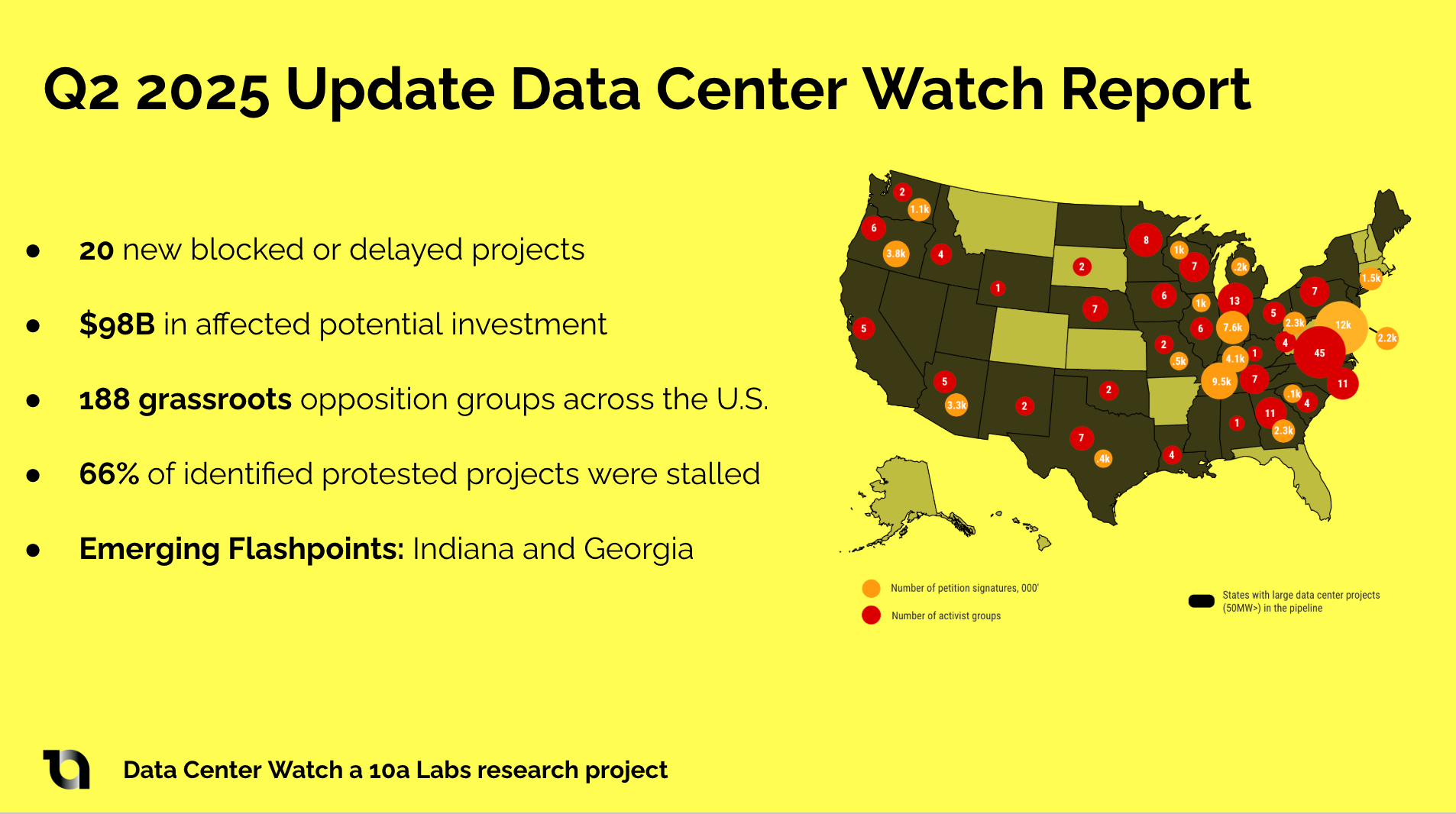
Data Center Watch Report Q2 2025
Check out our Data Center Watch Report for Q2 2025. Opposition to data centers is accelerating nationwide. In Q2 2025 alone, an estimated $98 billion in projects were blocked or delayed, more than the total for all previous quarters since 2023. As political resistance builds and local organizing becomes more coordinated, this is now a sustained and intensifying trend.
We wish our subscribers a happy holiday season and all the best in the New Year!