Briefing 11/21/2025
Weekly updates on the political risks American data center projects
This week’s round-up: In Pennsylvania, organized opposition in Plymouth Township helped force the withdrawal of a 2-million-square-foot AI data center proposal after they scrutinized filings and identified a standing flaw in the developer’s agreement with the landowner. In Michigan, Howell Township residents opposed a 1,000-acre campus and won a unanimous six-month moratorium on any data center approvals while officials reconsider zoning. And in Georgia, South DeKalb residents rallied against the 1-million-square-foot Ellenwood campus, prompting the DeKalb County Commission to extend its moratorium, defer the project, and advance a stricter countywide ordinance that would tightly regulate campus-scale data centers.
Developer pulls Plymouth Township, Pennsylvania, data center plan amid organized opposition and standing challenge
Developer Brian O’Neill / 900 Conshohocken LLC withdrew his application for a 2-million-square-foot AI data center at the former Cleveland-Cliffs steel mill in Plymouth Township, PA, after a packed zoning hearing raised a standing issue: the sale agreement with Cleveland-Cliffs was not finalized, so the developer lacked legal authority to seek zoning relief.
This procedural hit came after weeks of local opposition, including a planning agency recommendation to deny the special exception following a two-hour meeting in which more than 70 residents challenged its legality under “prohibited uses” and raised concerns about noise and pollution.
Opposition groups had already launched petitions (370+ signatures in October, climbing to 1,000+ by late November) and public campaigns arguing that natural-gas generation, diesel backup, and water use at the Schuylkill riverfront site would worsen air quality, strain the grid, and foreclose alternative riverfront redevelopment.
Why it matters:
Opposition scrutiny: A standing issue prompted the withdrawal of the project, but it only surfaced because residents, petition organizers, and groups like Delaware Riverkeeper Network had already been scrutinizing filings and organizing opposition.
Converging narratives: Opponents tied the project to electricity demand, higher bills, gas-turbine and diesel emissions, and environmental concerns, building a narrative that blends climate, health, and neighborhood-planning concerns.
Howell Township, Michigan, Imposes 6-Month Moratorium on Data Centers After Resident Backlash
The Howell Township Board (Livingston County, Michigan) voted unanimously to approve a six-month moratorium on “establishing, permitting, approval, and installation” any data center in the township.
The decision came after roughly 2 hours of public comment, during which residents from Howell Township and neighboring areas strongly opposed a proposed 1,000-acre data center project, citing transparency concerns, construction impacts (diesel fumes, dust), and long-term environmental and quality-of-life risks. Several board members spoke in favor of the project’s economic and job potential, but still supported the temporary pause.
The project is not yet blocked, but Howell Township’s moratorium signals rising political caution around mega-sites. Even boards that see data centers as economic wins may feel compelled to hit pause when transparency questions and construction-phase impacts become focal points of local opposition.
The board is scheduled to decide whether to rezone the proposed site at the December 8 meeting.
Why it matters:
Moratorium as a risk flag: A six-month pause creates immediate permitting uncertainty and gives the township space to tighten regulations and requirements for large-scale campuses. Even if the project eventually proceeds, timelines and costs may likely be affected.
Midwest greenfield pushback: This adds to a pattern of large rural/edge-of-town sites in the Midwest facing organized resident resistance, even without a large presence of hyperscaler developments. Other Michigan townships may look to Howell’s moratorium as a template.
DeKalb County, Georgia, delays data center rules and Ellenwood campus vote
On November 20, at a zoning meeting, the DeKalb County Commission deferred both a countywide data center ordinance and a proposed 1-million-square-foot data center campus in Ellenwood (Loveless Place/Pineview Trail). About two dozen residents rallied outside, and a hundred attended the hearing, with many South DeKalb residents opposing the campus and some calling for an outright county ban on data centers.
A moratorium on new data center applications runs through Dec. 16 and may be extended again. The Ellenwood campus application by PCC-DeKalb, LLC—a 95-acre, three-building campus with an outdoor substation in the Bouldercrest Overlay District and Soapstone Historic District—was recommended for denial by staff and deferred to Jan. 13, 2026, so zoning rules can be finalized first.
Why it matters:
Structured guardrails: DeKalb is moving toward a detailed zoning framework that distinguishes between minor and campus-scale projects, ties approvals to closed-loop water and impact studies, and restricts campuses to industrial zones with special land-use permits. That raises the bar on siting, especially for greenfield or overlay-district locations.
Georgia’s growing opposition: South DeKalb residents are linking data centers to energy costs, health, and historic-overlay protections, while Atlanta is simultaneously attracting large AI/data center investments.
This combination of data center growth pressure plus vocal, organized pushback signals higher political and permitting risk around the broader Atlanta region.
Mentions in the Press
“Data centers are surging—but so are the protests against them”
https://www.fastcompany.com/91444129/data-centers-surge-ai-boom-protests
“Will AI infra investors heed the lessons of the energy transition?”
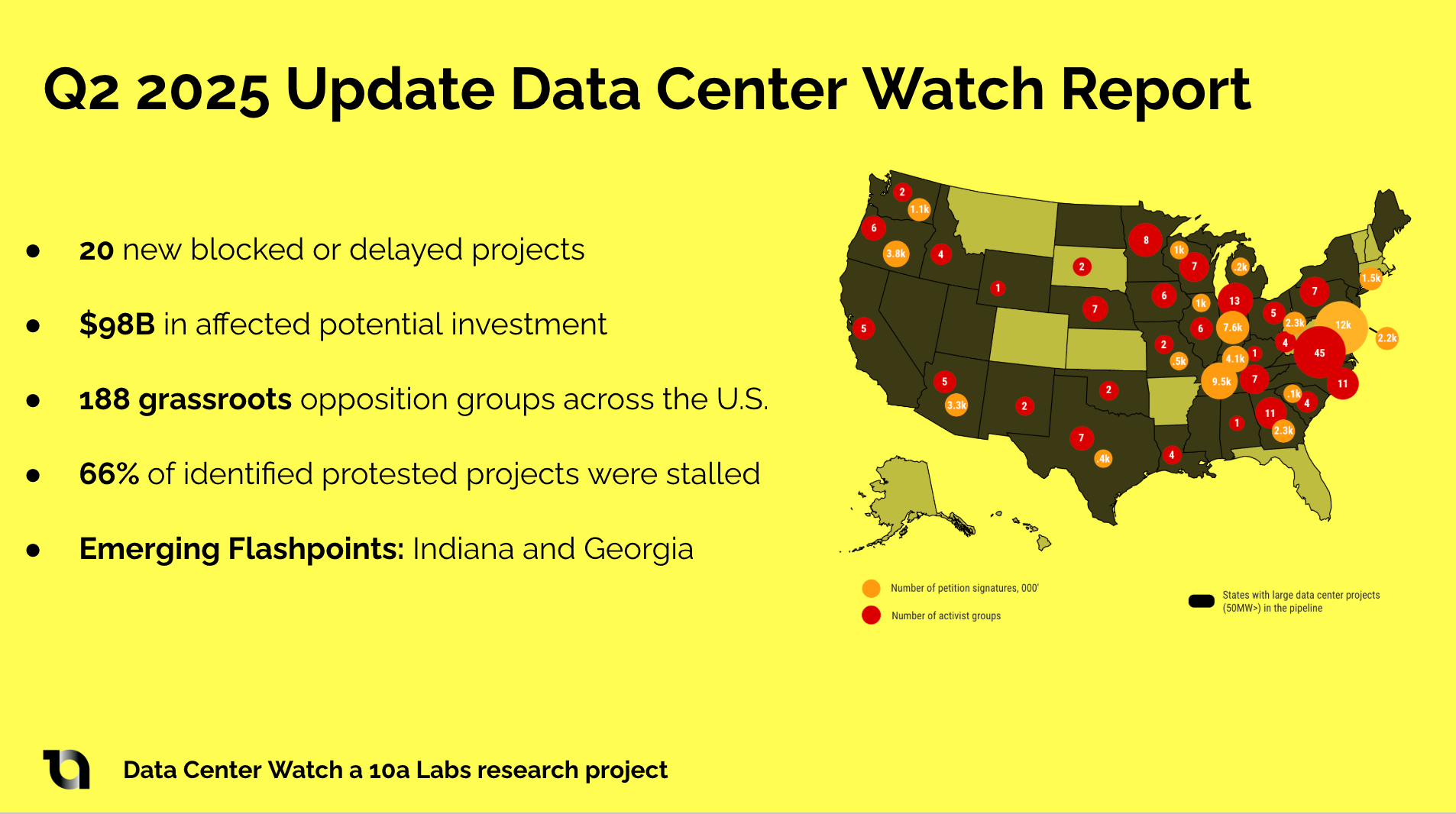
Data Center Watch Report Q2 2025
Check out our Data Center Watch Report for Q2 2025. Opposition to data centers is accelerating nationwide. In Q2 2025 alone, an estimated $98 billion in projects were blocked or delayed, more than the total for all previous quarters since 2023. As political resistance builds and local organizing becomes more coordinated, this is now a sustained and intensifying trend.