
New Report: Q2 2026
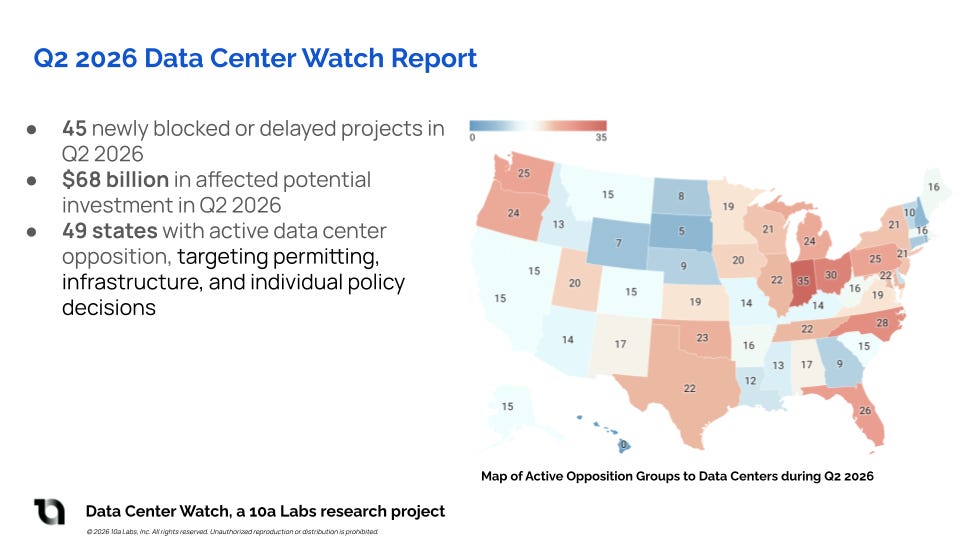
Data Center Watch has released its latest report covering developments in Q2 2026, analyzing the continued expansion of grassroots opposition, regulatory responses, and political debates surrounding data center development across the United States. The report provides updated data on blocked and delayed projects, emerging activist groups, and policy actions shaping the siting landscape.
The report is available for purchase. To learn more, contact us:
Communities Are Regulating Data Centers Before Projects Arrive
From Alaska to Florida, local and state governments are increasingly acting on data centers before specific projects are proposed. Moratoriums and other temporary restrictions are giving officials time to develop rules governing land use, infrastructure, water, electricity, and other potential impacts.
The trend marks a new phase in data center politics: regulatory uncertainty is no longer limited to communities responding to individual projects. Some governments are adopting restrictions before developers submit applications or publicly express interest.
Statehouses also remained active as Q2 legislative sessions wound down. Through legislation, executive orders, and regulatory directives, states considered or adopted measures addressing construction, tax incentives and exemptions, utility costs, and rules governing utility cost allocation. Counties and municipalities similarly used moratoriums, interim controls, zoning rules, and other measures to manage future development.
Recent preemptive actions include:
Santa Fe County, New Mexico: On June 30, the county adopted the state’s first preemptive data center moratorium, pausing new construction for 18 months while officials develop land-use regulations and environmental standards.
Superior, Wisconsin: On June 16, the city enacted a one-year moratorium after Google proposed a $2 billion hyperscale data center in neighboring Hermantown, Minnesota.
Harpersville, Alabama: On August 3, the Town Council adopted a six-month moratorium after neighboring communities were approached about data center development, even though Harpersville had not received a proposal.
Jefferson, Texas: After Gov. Greg Abbott issued a statewide grid-connection pause and audit order, the City Council unanimously adopted a resolution on August 10 opposing data center development and calling for further consideration of potential effects on utilities, public safety, and the local economy.
Independence County, Arkansas: On August 10, Officials enacted a data center moratorium through 2031, citing constraints on the local water supply despite the absence of a specific project proposal.
Data centers are also moving onto ballots. Seventeen data center-related ballot measures have advanced during the 2026 election cycle, while another 10 were proposed but did not advance. The measures address several issues, including zoning, voter approval of new projects, energy and water use, noise limits, and financial guarantees associated with tax abatements.
The policy response also crossed partisan lines, with Republican- and Democratic-controlled states advancing targeted measures addressing data center development. There is limited evidence that support for or opposition to data centers consistently determines election outcomes. Candidates in both parties, however, are increasingly treating data center development as an electoral issue, adding another source of political scrutiny for future projects.
Why it matters:
Communities are no longer waiting for projects to arrive.
Some local governments are adopting temporary restrictions before applications are filed, allowing officials to establish development rules before considering individual projects.
Local zoning and regulatory capacity have become important policy levers.
Governments have used moratoriums to create time to develop rules governing siting, setbacks, noise, electricity, water, environmental review, and infrastructure.
Infrastructure costs have become a more prominent part of the policy debate.
Communities are increasingly raising questions about generation and transmission upgrades, utility rates, and how infrastructure costs associated with new development should be allocated.
Disclosure requirements have become another source of regulatory scrutiny.
Concerns over undisclosed project terms, tax incentives, and nondisclosure agreements have contributed to calls for greater disclosure and, in some states, restrictions on the use of NDAs.
Mentions in the Press
New Data Centers Worth $68 Billion Disrupted in US, Data Show https://www.bloomberg.com/news/articles/2026-09-21/new-data-centers-worth-68-billion-disrupted-in-us-data-show
AI backlash puts $68 billion in U.S. data center projects on hold https://www.latimes.com/business/story/2026-09-22/ai-backlash-puts-68-billion-in-u-s-data-center-projects-on-hold
Is US data center opposition a ‘China PR thing,’ as Trump says? Experts say that’s exaggerated https://politifact.com/article/2026/sep/23/china-influence-data-center-opposition/
Nearly $200 Billion Worth of Data Center Projects Have Been Blocked or Delayed This Year https://gizmodo.com/nearly-200-billion-worth-of-data-center-projects-have-been-blocked-or-delayed-this-year-2000815054
CT town turns against data centers: ‘Yes, please’ becomes ‘No way’ https://www.courant.com/2026/09/21/ct-town-turns-against-data-centers-yes-please-becomes-no-way/
Everyone can find a reason to dislike data center construction https://techcrunch.com/2026/09/22/everyone-can-find-a-reason-to-dislike-data-center-construction/
Pleasure to subscribe
World War II ended in 1945.
Apparently, nobody told the periodic table.
I served in the Navy. Years later, I examined metallic debris recovered from Iwo Jima, where American and Japanese forces fought more than eight decades ago.
The explosives I tested were below laboratory reporting limits. The metals were still there.
That doesn't mean the entire island is contaminated. It means the environmental history of warfare is considerably longer than the military history we prefer to commemorate.
We maintain aircraft, inspect weapons, and account for military equipment. But who maintains a battlefield eighty years after the war?
I wrote about what the soil is still telling us.
The War Is Over But the Soil Disagrees.
https://abonussituation.substack.com/p/the-war-is-over-but-the-soil-disagrees