
Briefing 05/01/2026
Weekly updates on the political risks American data center projects
This week’s round-up: In Maine, Gov. Janet Mills vetoed LD 307, an 18-month statewide moratorium on large data centers that had passed the Legislature, making it the first state-level data center moratorium to clear a state legislature but not become law. In Virginia, Compass Datacenters pulled out of the $24.7B Prince William Digital Gateway after years of opposition In Michigan, residents in Lyon Township launched a recall effort against township leaders for their support to Project Flex. And in Florida, Okeechobee County effectively blocked the Okee-One data center after a 3,000-signature petition and public opposition.
New Report: Q3-Q4 2025
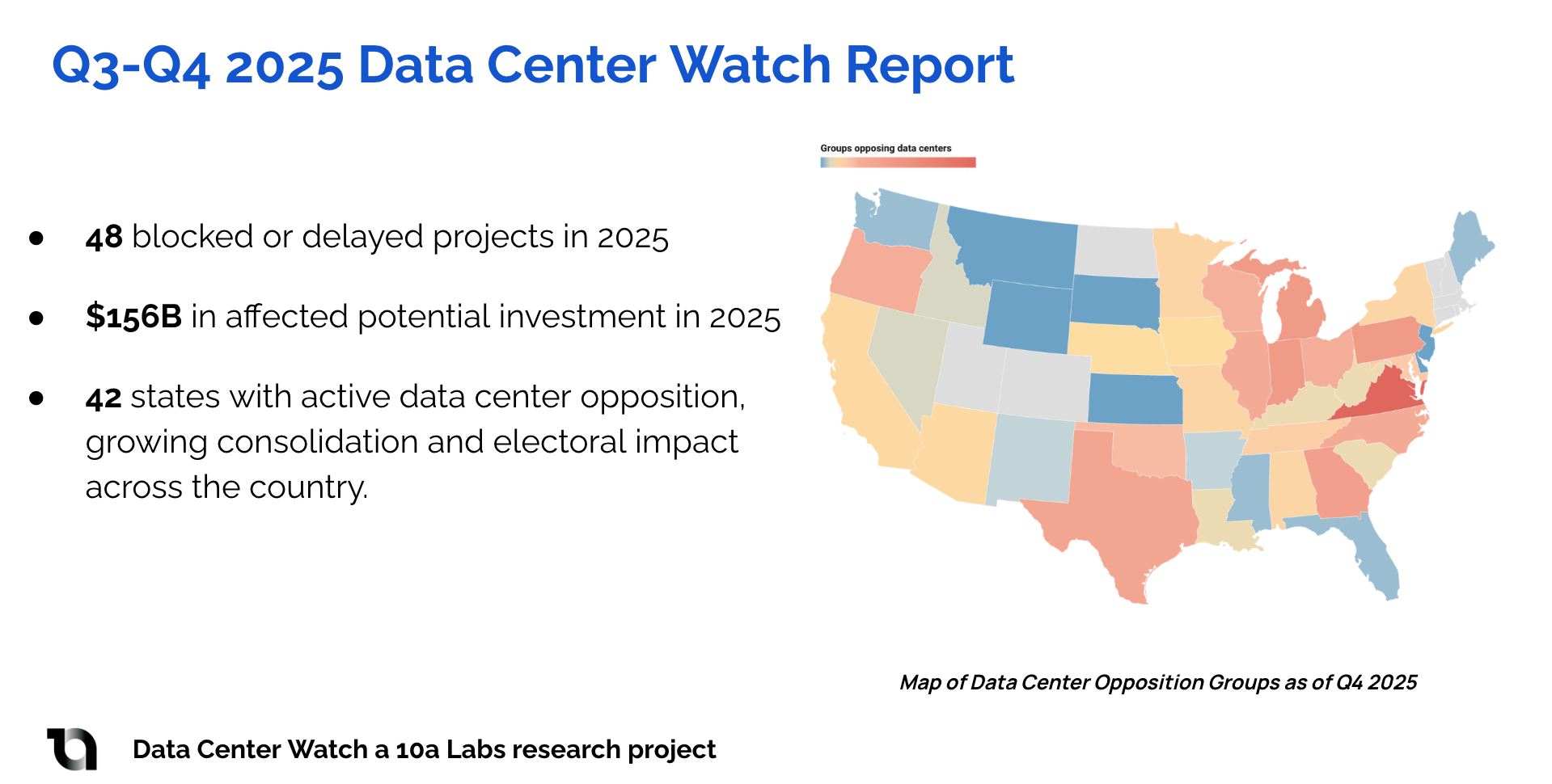
Data Center Watch has released its latest report covering developments in Q3–Q4 2025, analyzing the continued expansion of grassroots opposition, regulatory responses, and political debates surrounding data center development across the United States. The report provides updated data on blocked and delayed projects, emerging activist groups, and policy actions shaping the siting landscape.
The report is available for purchase. To learn more, contact us:
Maine Governor Vetoes Statewide Data Center Moratorium After Fight Over $550M Jay Project
Maine Gov. Janet Mills vetoed LD 307, a bill that would have imposed an 18-month moratorium on data centers using more than 20 MW of power and created a state council to study the sector’s impacts. The vetoed bill was the first statewide data center ban passed in the United States.
Mills said she supported a temporary pause in principle, but opposed the bill because it did not exempt a proposed $550 million data center redevelopment at the former Androscoggin Mill in Jay.
The veto highlights a split inside the politics of data center regulation. On one side, lawmakers and environmental groups pushed for a statewide pause to study energy, water, grid, and community impacts. On the other, Mills and local supporters of the Jay project argued that a blanket moratorium could block a major redevelopment opportunity in a former mill town.
After vetoing the bill, Mills signed an executive order creating the Maine Data Center Advisory Council, with recommendations due by January 29, 2027. The outcome keeps the Jay project pathway open while preserving the broader political signal: statewide data center moratoria are now moving from local backlash into state-level legislative fights.
Why it matters:
Statewide moratoria are becoming politically viable: Even though LD 307 was vetoed, the bill advanced far enough to show that statewide pauses on data center development are now a serious policy tool.
Economic-development carve-outs will shape future fights: The Jay project shows how proposed moratoria can divide policymakers when data centers are tied to redevelopment, jobs, or reuse of legacy industrial sites.
Compass Exits PW Digital Gateway After Court Ruling, Resident Opposition, and Tax Break Uncertainty
Compass Datacenters has pulled out of the Prince William Digital Gateway, a proposed 2,100-acre, multi-gigawatt data center corridor in Prince William County, Virginia, after years of local opposition, litigation, and growing uncertainty around Virginia’s data center tax incentives. County finance officials had estimated the project’s potential investment value at $24.7 billion, while local supporters also promoted it as a transformative source of tax revenue.
The project, led by Compass and QTS, would have expanded Northern Virginia’s data center footprint beyond Loudoun County and created one of the world’s largest data center corridors. Compass alone had spent tens of millions of dollars seeking approvals for more than 800 acres before concluding that public opposition, court losses, and state-level resistance to data center tax breaks created too many obstacles.
Opposition emerged early over the site’s proximity to a Civil War battlefield, rural land conversion, property values, transmission infrastructure, and the scale of the buildout. The decisive setback came through litigation: opponents argued that Prince William County failed to follow public notice requirements before approving the zoning. Courts agreed and invalidated the approvals. Compass chose not to appeal, while QTS may still continue. A separate landowner lawsuit against QTS adds further uncertainty.
Why it matters:
Opposition can convert procedural errors into project-ending risk: The Digital Gateway was stalled by a legal challenge over public notice, rather than by a moratorium or denial of permitting. That shows how transparency and process failures can become decisive blocking mechanisms.
Local opposition can reshape political support: Opposition to the Digital Gateway project turned data center growth into an election issue in Prince William County and weakened the political conditions for the project's success.
Opposition to Project Flex turns into a Recall of Lyon Township officials
In Lyon Township, Michigan, residents have launched a recall effort against all seven members of the township board after months of opposition to Project Flex, a proposed 1.8 million-square-foot hyperscale data center by Walbridge and operator Verrus, reportedly on behalf of Anthropic. The project would include six buildings and an on-site utility substation on roughly 172 acres between Milford Road and South Hill Road.
The opposition is led by No Data Center Lyon Township, a grassroots group of more than 2,000 residents. Opponents argue the project would strain infrastructure, affect property values, create environmental and safety risks, and was advanced without enough public input because the site was already zoned for industrial use. The township had already enacted a six-month moratorium on additional data center proposals in March, but officials say they lack legal authority to overturn the Planning Commission’s conditional approval.
While the recall petition language focuses on township salary increases, organizers acknowledge the recall effort is tied to frustration over Project Flex.
Why it matters:
“By-right” approvals can still face backlash: Project Flex appears to have advanced because the site was already zoned for industrial use, but opponents are now challenging the broader legitimacy of the process, arguing that a hyperscale data center should not be treated like a routine industrial project.
Data Center opposition is becoming an electoral risk: The recall effort shows how opposition can shift from stopping a project to holding local leaders politically accountable, especially when residents believe they were denied meaningful input.
Okeechobee County Blocks Okee-One Data Center Public Opposition
Okeechobee County effectively shut down the Okee-One data center proposal after county commissioners removed the “Special Technology Opportunity Centers” designation from the county’s long-term growth plan. That change eliminated the pathway for a proposed 205-acre data campus led by Indian River State College on the former Okeechobee School for Boys site.
The project was relatively small by hyperscale standards, at roughly 9–10 MW, but it became politically volatile after opponents raised concerns about transparency, water use, electricity costs, noise, pollution, and whether the promised workforce-training benefits justified the industrial use. A Change.org petition gathered more than 3,000 signatures, and a planned protest was canceled only after the county moved to kill the project.
The backlash also reached the state level. Gov. Ron DeSantis’ administration had initially provided $1.5 million from the Rural Infrastructure Fund to support the project, but later withdrew support as local opposition intensified.
Why it matters:
Small projects can still trigger major backlash: Even a 9–10 MW proposal became politically untenable once residents questioned transparency, water impacts, and public benefits.
Politicians are increasingly sensitive to data center opposition: The project lost Gov. Ron DeSantis’ backing after local opposition intensified, showing that elected officials are paying attention to growing opposition to data centers.
Mentions in the Press
Data centers are spreading around the country. Now, data-center bans are, too
https://www.cnn.com/2026/04/12/climate/maine-data-center-ban-bill
AI data center backlash threatens Pennsylvania GOP incumbents in 2026 election
https://www.cnbc.com/2026/04/24/ai-data-centers-pennsylvania-republicans-2026-election.html
In this U.S. hot spot for data centers, voters have turned against them
https://www.washingtonpost.com/business/2026/04/15/data-centers-poll-virginia/
Anti-data center measures gain traction at state, local level
https://thehill.com/policy/technology/5843665-data-center-backlash-grows/
Data Center Protests Are Growing. How Should the Industry Respond?
https://www.datacenterknowledge.com/data-center-construction/data-center-protests-are-growing-how-should-the-industry-respond-
Maine becomes first US state to pass data centre construction ban
https://www.ft.com/content/4deedaf0-23e4-4ec1-9b10-b50d63615a93?syn-25a6b1a6=1
The great American data centre divide
https://www.ft.com/content/ba4e8e02-11e9-437c-b6a9-89778647a6cc?syn-25a6b1a6=1
Data Center Protests Are Growing. How Should the Industry Respond?
https://www.datacenterknowledge.com/data-center-construction/data-center-protests-are-growing-how-should-the-industry-respond-
Hi - I gave a shout out to Data Center Watch in my latest post. Feel free to restack and/or make suggestions.
https://cleanenergynow.substack.com/p/local-communities-are-stopping-data?r=6c28ip&utm_campaign=post&utm_medium=web&showWelcomeOnShare=true
Totally against these data centers! Too much damage to the area for the good. Actually nothing good!