
Briefing 04/10/2026
Weekly updates on the political risks American data center projects
This week’s round-up: In Missouri, voters in Festus removed all city council incumbents following backlash to a proposed $6B data center. In Michigan, Deep Green withdrew its Lansing data center proposal after early-stage opposition led by residents and activist group Sunrise Spartans, highlighting rising pre-permitting risk. In Maine, the Maine House of Representatives advanced a statewide moratorium bill. And in California, Imperial County approved a major data center complex despite strong local opposition.
Festus, Missouri, Election Upends City Leadership After $6B Data Center Fight
A proposed $6 billion data center project in Festus, Missouri, became a defining issue in local elections, leading voters to recall all incumbent city council members. The project faced opposition over how it was introduced and advanced, with opposing residents raising concerns about transparency, governance, and the pace of decision-making. The opposition’s key narrative was a lack of transparency about key details of infrastructure demands, land-use changes, and community impacts, generating distrust of city leadership.
As opposition grew, the issue expanded beyond the project itself into a referendum on local governance. During the election cycle, challengers used the data center issue in their campaigns, ultimately unseating the entire council.
While the project’s future remains uncertain, the political consequences are already clear, marking a case where a data center proposal directly reshaped local leadership through the ballot box.
Why it matters:
Data centers are becoming electoral issues: Projects are now influencing local elections, even forcing recalls of elected officials.
Transparency is a key risk factor: Perceived gaps in public engagement are emerging as a central factor in local opposition, often shifting political accountability onto local officials.
Data Center Proposal Withdrawn After Early Backlash in Lansing, Michigan
A proposed data center project in Lansing by Deep Green was withdrawn following several weeks of public opposition. Public meetings drew a strong turnout, with attendees pressing both the developer and city officials on transparency and the project’s long-term implications, particularly whether it could open the door to additional large-scale developments in the area.
Among the organized voices, Sunrise Spartans, a youth-led climate activist group, helped mobilize attention and frame the project within broader environmental and energy debates. While Lansing officials did not formally reject the project, the lack of clear political backing combined with sustained public pressure created uncertainty around its viability. The developer ultimately withdrew before entering a formal rezoning or permitting phase.
Why it matters:
Pre-permitting risk is increasing: the Lansing project illustrates how proposals can be stopped at the announcement stage, before any formal permitting process begins.
Activist groups are amplifying local opposition: The presence of groups like Sunrise Spartans shows that local data center disputes are increasingly being tied to broader environmental and energy narratives, rather than remaining purely local issues.
Maine: Lawmakers Advance Statewide Data Center Moratorium
The Maine House of Representatives advanced legislation that would impose a statewide moratorium on new data center developments while the state studies their long-term impacts. The bill reflects growing concern among lawmakers about the rapid expansion of public sentiment opposition tied to narratives about the costs of energy-intensive infrastructure and its implications for electricity demand, environmental sustainability, and land use planning.
While the bill still requires additional legislative steps, its advancement signals a growing willingness at the state level to intervene proactively rather than rely solely on local zoning processes to manage growth. Currently, 11 states are considering bills to enact data center moratoriums.
Why it matters:
Moratoria are scaling to the state level: Maine could set a precedent for other states, as policymakers are using temporary bans to gain time to define regulatory frameworks.
Energy demand concerns are driving policy: Legislators are focusing on grid capacity and long-term planning before approving large-scale projects.
Imperial County, California, Approves Large Data Center Complex Despite Opposition
The Imperial County Board of Supervisors approved a data center campus in Imperial County after a heated public process marked by sustained opposition from residents and environmental advocates. The project, described as one of the largest proposed in the region, was promoted by local officials as a major economic development opportunity tied to job creation and long-term tax revenue. However, critics gathered at public hearings arguing about excessive water consumption and environmental impacts.
Opposition coalesced across multiple layers, led by the grassroots group “Not In My Back Yard Imperial (NIMBY Imperial)”, which gathered over 3,400 petition signatures, and Imperial Valley Equity and Justice. Residents also launched a ballot initiative to ban data centers, a recall effort targeting Board Chair Peggy Price, and large-scale public protests.
The April 6 hearing saw a reversal in turnout, with supporters of the project from the Laborers’ International Union of North America (LiUNA) filling the room. Early arrivals by union members and participation limits on residents heightened tensions between supporters and local opposition, adding to tensions that had already escalated with the developer.
In this context, supervisors voted to move the project forward, signaling alignment with development priorities and a willingness to approve large infrastructure projects even amid organized resistance.
Why it matters:
Opposition does not always lead to delays: Projects can move forward when local governments prioritize economic development over the concerns of local opposition groups.
Supporters mobilization: This is one of the few cases so far where project supporters have successfully mobilized to counterbalance opposing voices.
Mentions in the Press
Is AI the new fracking?
https://www.ft.com/content/525cc89e-1ee9-4039-a588-5039565053f9?syn-25a6b1a6=1
Port Washington data center vote draws local backlash
https://thehill.com/policy/technology/5822566-port-washington-data-center-vote/
Locals Are Using AI to Fight Data Centers Being Built in Their Backyards
https://www.wsj.com/pro/sustainable-business/locals-are-using-ai-to-fight-data-centers-being-built-in-their-backyards-d0642630
Data reveals at least 48 data centers planned across US amid growing concerns
https://finance.yahoo.com/sectors/technology/articles/data-reveals-least-48-data-203000832.html
Coweta votes to turn this 800-acre forest into $17B data center campus
https://www.ajc.com/business/2026/04/coweta-votes-to-turn-this-800-acre-forest-into-17b-data-center-campus/
AI struggles to model angry Main Street mobs
https://www.reuters.com/commentary/breakingviews/ai-struggles-model-angry-main-street-mobs-2026-04-10/
How AI Data Centers Are Shaping Politics
https://www.lawfaremedia.org/article/how-ai-data-centers-are-shaping-politics
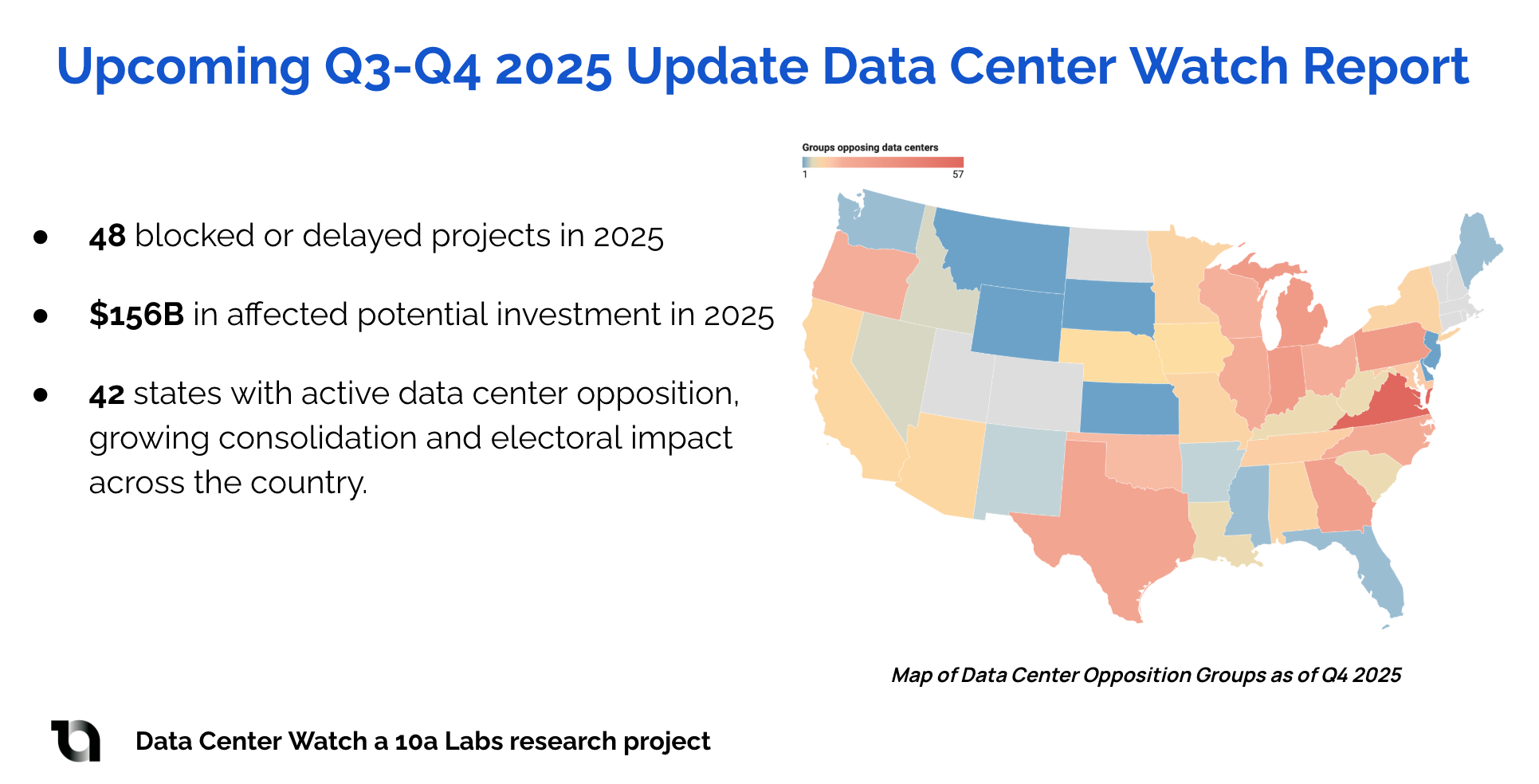
Upcoming update: Q3-Q4 2025
Data Center Watch will soon release its next report covering developments in Q3–Q4 2025, analyzing the continued expansion of grassroots opposition, regulatory responses, and political debates surrounding data center development across the United States. The report will provide updated data on blocked and delayed projects, emerging activist groups, and policy actions shaping the siting landscape.
Stay tuned for the full release!
Thank you for the update! Data centers require massive electrical infrastructure to operate. Research indicates that electromagnetic field (EMF) exposure from the high-voltage power lines and electrical substations necessary for these facilities is associated with childhood leukemia and other serious health and environmental impacts. https://ehsciences.org/data-centers-increase-electromagnetic-fields-emf-exposure/