
Briefing 03/13/2026
Weekly updates on the political risks American data center projects
This week’s round-up: In North Carolina, Apex moved toward a one-year moratorium on data centers after the withdrawal of the proposed New Hill Digital Campus, signaling that local governments may continue using temporary bans to buy time for zoning rules. In Florida, opposition to Palm Beach County’s “Project Tango” widened as Wellington’s mayor urged state lawmakers to back new restrictions on large data centers near homes and schools. In Pennsylvania, House lawmakers advanced bills that would give municipalities a model framework for data center siting and require annual reporting on water and energy use. And in Virginia, the state’s long-running data center tax break came under direct challenge as senators backed a repeal effort worth roughly $1.6 billion annually.
Denver proposes data center cutoff as opposition grows against tax incentives
The Apex Town Council in Wake County voted to have staff draft a one-year moratorium on new data centers after the developer behind the proposed 300 MW New Hill Digital Campus withdrew its project. Mayor Pro-Tem Terry Mahaffey said the pause would give the town time to write data center-specific zoning rules. WUNC reported that the move followed similar action in nearby Chatham County, underscoring a broader regional shift toward “rules first” approaches.
Why it matters:
Moratoria are spreading as a tool to gain time. Apex is using a temporary freeze to create zoning guardrails before another project application arrives.
Political impacts after a project’s withdrawal. Even after New Hill was pulled, officials moved to formalize restrictions, suggesting opposition can outlast a single project and reshape future siting conditions.
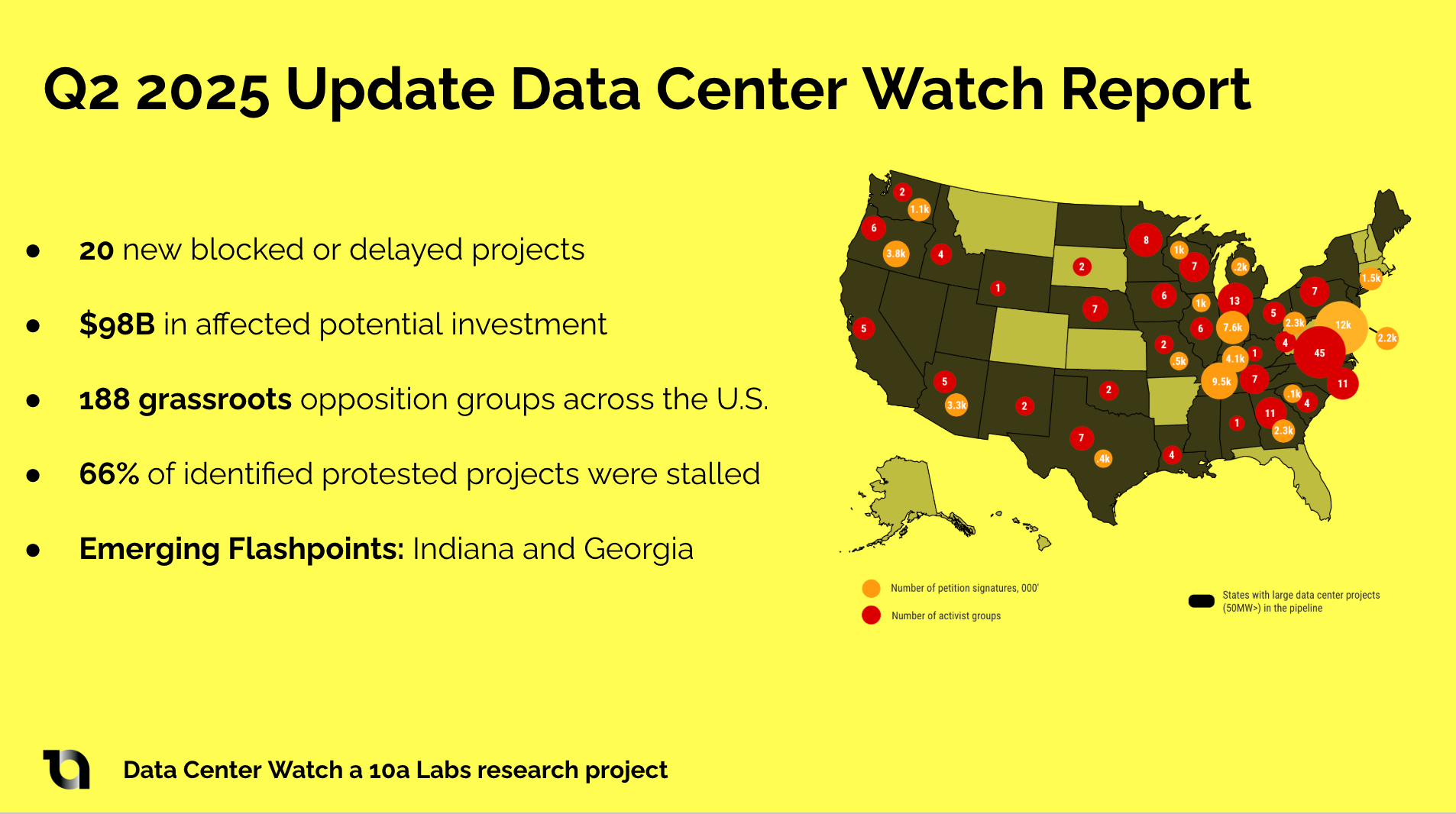
Data Center Watch Report Q2 2025
Check out our Data Center Watch Report for Q2 2025. Opposition to data centers is accelerating nationwide. In Q2 2025 alone, an estimated $98 billion in projects were blocked or delayed, more than the total for all previous quarters since 2023. As political resistance builds and local organizing becomes more coordinated, this is now a sustained and intensifying trend.
Wellington Mayor Joins Push Against Florida’s “Project Tango”
Wellington Mayor Michael Napoleone formally urged Tallahassee lawmakers to support bills, including SB 484 and HB 1007, as opposition to Project Tango, a planned hyperscale AI data center in western Palm Beach County, continued to grow.
Residents near Arden and Fox Trail raised concerns about water use, power demand, air quality, noise, and impacts on Wellington’s equestrian economy. The project remains in limbo ahead of an April 23, 2026, county hearing.
Why it matters:
Data Center opposition growing in Florida. Florida isn’t currently one of the top US data center markets. Project Tango is a test case for whether Florida will continue its permissive approach to AI infrastructure or move toward stricter siting rules when projects collide with organized suburban and rural communities.
Local opposition is now connecting directly to state legislation. This case shows how opposition to data centers goes beyond county zoning disputes and rises into statewide debates over setbacks, local consent, and utility oversight.
Pennsylvania House Advances Bills on Data Center Siting Rules and Resource Reporting
A Pennsylvania House committee advanced two Democratic-backed data center bills: HB 2150, sponsored by Rep. Kyle Mullins, would require annual reporting of data centers’ energy and water use, while HB 2151 would create a state-issued model local ordinance municipalities could adopt to regulate where and how data centers are built. Rep. Elizabeth Fiedler argued the bills are aimed at transparency and fairness, while Republicans including Rep. Mike Armanini warned they could weaken the state’s competitiveness.
The introduction of the bills can be read as a reaction to growing data center opposition in Pennsylvania, in places such as Springdale.
Why it matters:
Pennsylvania is moving toward a structured local-regulation framework. A model law could make it easier for towns to enact clearer, data center-specific rules rather than negotiating ad hoc.
Transparency mandates could raise political and compliance pressure. Required reporting on energy and water use would give residents, regulators, and lawmakers more concrete tools to scrutinize future projects.
Virginia Tax Break Fight Escalates as Senators Back Repeal
Virginia senators voted to end the state’s major data center tax break, which allows qualifying companies to avoid the state’s 5.3% sales tax on equipment and software and is valued at about $1.6 billion annually. Supporters of the repeal, including Democratic Sen. L. Louise Lucas, argued the mature industry should contribute more, while opponents, including the Data Center Coalition, warned that ending the incentive could halt investment. Gov. Abigail Spanberger also signaled caution about reversing prior commitments to businesses.
Virginia remains the clearest sign that data center politics have moved from zoning boards to state fiscal policy. Once tax incentives themselves become politically vulnerable, the industry’s operating assumptions begin to change.
Why it matters:
Virginia’s political center of gravity is shifting. While local decision-making remains key in data center politics, in Virginia we see targeted one of the industry’s most important statewide incentives.
A repeal in the country’s largest data center market would have a national impact. Other states are already reconsidering tax exemptions, and Virginia’s precedent could further legitimize efforts to scale back tax incentives elsewhere.
Mentions in the Press
Data Center Developers Battle For Hearts And Minds For Their Projects
https://www.bisnow.com/national/news/data-center/power-and-people-how-data-centers-are-selecting-sites-133548
New data centers threaten California’s limited water resources
https://www.sfchronicle.com/opinion/openforum/article/ai-data-centers-water-west-california-climate-21896055.php
The “Data Center Rebellion” Is Here
https://www.oreilly.com/radar/the-data-center-rebellion-is-here/
Metro Atlanta cities wrestle with when to stop approving data centers
https://www.ajc.com/business/2026/03/metro-atlanta-cities-question-how-many-data-centers-are-too-many/
Tech Bosses Tell Trump They’ll Pay Up for Electricity
https://www.barrons.com/articles/tech-bosses-tell-trump-will-pay-electricity-bdeb21ec
Soaring Power Prices Send US on Search for Solutions
https://www.bloomberg.com/news/articles/2026-03-04/soaring-power-prices-have-us-politicians-searching-for-solutions
Upcoming update: Q3-Q4 2025
Data Center Watch will soon release its next report covering developments in Q3–Q4 2025, analyzing the continued expansion of grassroots opposition, regulatory responses, and political debates surrounding data center development across the United States. The report will provide updated data on blocked and delayed projects, emerging activist groups, and policy actions shaping the siting landscape.
Stay tuned for the full release!
Great to hear that the Q3-Q4 update will be out soon! Heatmap counted 25 cancellations last year https://heatmap.news/politics/data-center-cancellations-2025
I'll be curious to see how your analysis compares.