Briefing 02/27/2026
Weekly updates on the political risks American data center projects
This week’s round-up: In Denver, Colorado, city leaders moved toward a temporary moratorium as the city reassesses zoning, energy, and water rules tied to CoreSite’s expansion. In Sangamon County, Illinois, local officials rejected a proposed six-month moratorium and advanced a $500 million CyrusOne campus to the full County Board. In Pacific, Missouri, developer Beltline Energy withdrew its $16 billion rezoning request minutes before a packed public hearing, effectively pausing the project amid funding questions and environmental scrutiny. And in Huron County, Michigan, rural residents are mobilizing ahead of zoning amendments to facilitate data center development.
Denver proposes data center cutoff as opposition grows against tax incentives
In Denver, Mayor Mike Johnston and members of the Denver City Council jointly announced plans to pursue a moratorium on new data center construction within city limits until a more restrictive regulatory framework is developed.
The proposal comes amid mounting opposition in north Denver neighborhoods, particularly Globeville-Elyria-Swansea, where CoreSite is expanding a large data center campus near 49th and Race Streets. Community members argue the facilities are power- and water-intensive and add to cumulative environmental burdens in an area already impacted by highways, industrial zoning, the Suncor refinery, and a Superfund site.
The nonprofit GES Coalition is circulating a petition calling for stronger community protections and criticizing what it describes as decades of environmental injustice. Residents are organizing public forums and demanding greater transparency around environmental impacts, water use, and electricity demand.
Denver’s proposed moratorium would allow the city to review data center-specific rules on zoning, energy and water usage, and ratepayer impacts before approving additional projects.
Why it matters:
Urban moratorium risk: Denver joins a growing list of cities considering temporary pauses to reassess zoning and environmental safeguards, potentially slowing expansion in emerging markets.
Tax incentive backlash: Colorado lawmakers are openly debating whether data centers should receive long-term tax exemptions, signaling rising fiscal scrutiny of incentive packages.
Sangamon County, Illinois, denies a moratorium and approves the recommendation for a data center near Waverly
In Sangamon County, Illinois, the County Board’s zoning and land use committee voted 5–3 against a proposed six-month moratorium on new data center approvals. Immediately afterward, the county’s Zoning Board of Appeals unanimously recommended that CyrusOne receive a conditional permitted use to build a $500 million data center in Talkington Township, near Waverly.
The proposed campus would span 280 acres of farmland, adjacent to the Double Black Diamond solar farm. The project has drawn sustained opposition from residents, citing loss of farmland, diesel backup-fuel risks, water use, and potential impacts on electricity rates. At contentious back-to-back meetings, residents criticized the moratorium vote occurring before public comment.
At the state level, JB Pritzker signaled broader caution on the sector, proposing a two-year suspension of state data center tax credits in his State of the State address, citing affordability and grid stability concerns. The final decision now moves to the full Sangamon County Board, with a vote possible March 23.
Why it matters:
Moratorium attempt fails: Despite visible community backlash, local officials rejected a county moratorium, signaling that organized opposition does not always translate into regulatory delays.
Incentive volatility: Despite the failure of the moratorium on data centers in Sangamon County, in Illinois, there is a proposed pause on data center tax credits, signaling potential shifts in Illinois’ industrial policy, adding another variable to long-term project economics, and raising questions about the stability of state-level incentive regimes.
Betline Energy withdraws a $16 billion data center proposal in Pacific, Missouri
In Pacific, Franklin County, Missouri, a special Planning and Zoning Commission meeting ended within minutes after developer Beltline Energy withdrew its rezoning request for a proposed $16 billion data center project.
The auditorium was packed with residents who had prepared to speak against the project. The Pacific Board of Aldermen had approved a contract days earlier to hire expert consultants to review the proposal, and the zoning meeting was expected to include public testimony. Beltline Energy cited an inability to finalize a funding agreement as the reason for pulling the application.
The Missouri Department of Conservation flagged the site for habitat of endangered bats, salamanders, and other species and requested collaboration to mitigate ecological risks.
It is currently unclear when the rezoning request will return for consideration.
Why it matters:
Procedural block via withdrawal: While not a formal rejection, the tabling of the rezoning request effectively pauses the project and reflects mounting local resistance.
Environmental permitting risk: If a proposed site overlaps with protected habitat or endangered species areas, developers may face additional studies, mitigation requirements, or legal challenges that can delay or complicate approvals.
Huron County, Michigan, residents rally against solar farms and data centers
In Huron County, Michigan, a grassroots coalition of farmers and rural residents is organizing against potential data center and renewable energy developments on agricultural land, as county officials weigh zoning amendments.
The group formed after speaking at county meetings opposing solar farms, data centers, wind turbines and battery storage projects. While not a formal organization, they are now coordinating outreach efforts to advocate for the preservation of farmland and responsible development.
Their organizing comes ahead of county consideration of zoning amendments, following a February 4 Planning Commission recommendation and a scheduled February 24 County Board review.
Why it matters:
Farmland preservation framing: Opposition in rural Michigan is increasingly linking data centers to food security and generational land stewardship, a narrative that resonates politically in agricultural counties.
Early-stage mobilization risk: Even without a specific named project, organized rural pushback can shape zoning rules before developers formally apply.
Mentions in the Press
Tech Giants Are Paying Up to Power AI. These Utilities Will Be Big Winners.
https://www.barrons.com/articles/ai-energy-utility-stocks-buy-7cf4c92f
Elon Musk’s makeshift AI power plant generates sound and fury in Mississippi
https://www.nbcnews.com/news/us-news/musks-ai-power-plant-generates-sound-fury-mississippi-rcna258594
America’s hottest NIMBY issue: Data centers
https://www.businessinsider.com/americas-hottest-nimby-issue-data-centers-sanders-desantis-2026-2
Local opposition creates roadblocks for AI boom
https://www.axios.com/2026/02/24/ai-data-centers-energy-bills
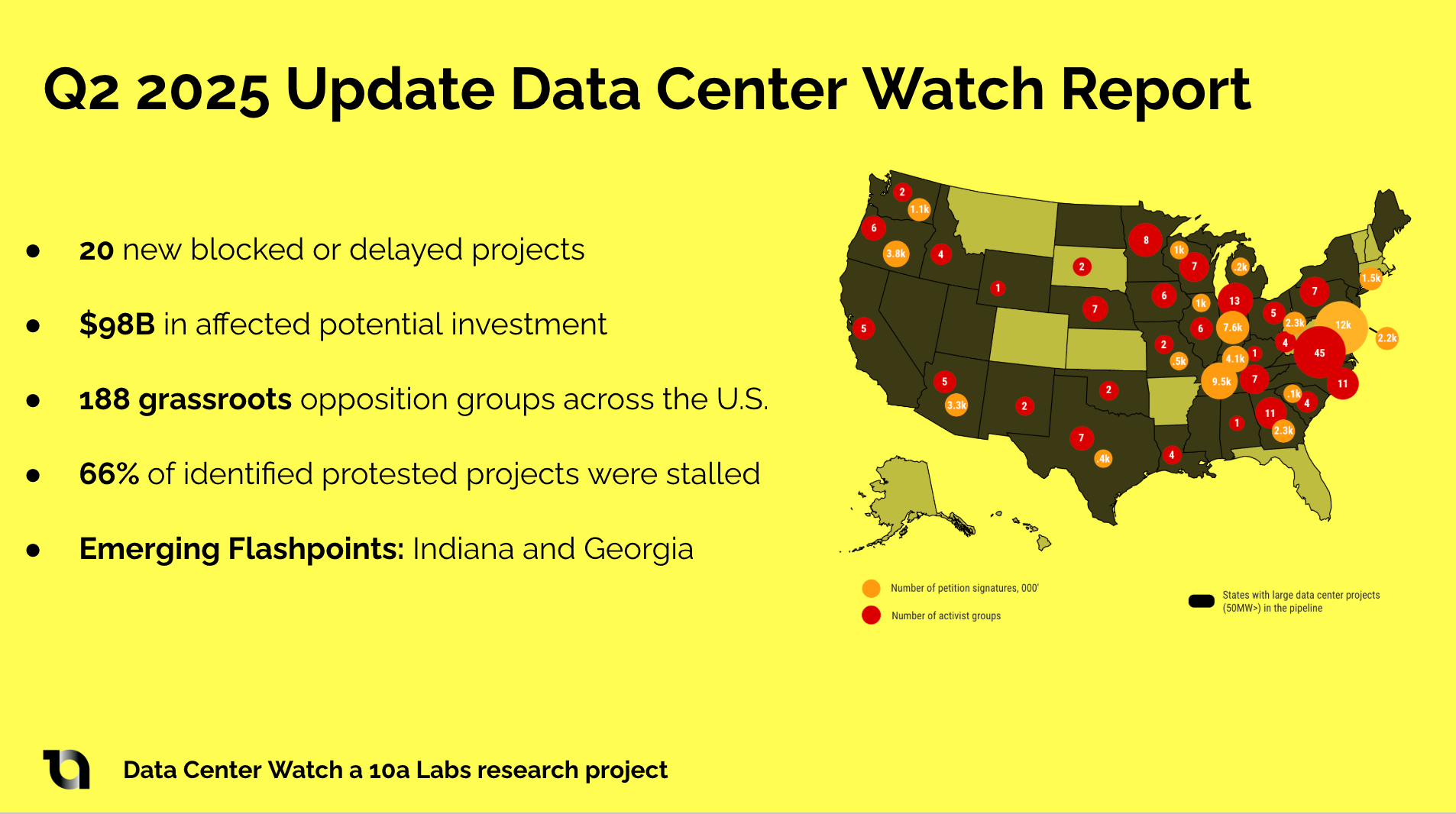
Data Center Watch Report Q2 2025
Check out our Data Center Watch Report for Q2 2025. Opposition to data centers is accelerating nationwide. In Q2 2025 alone, an estimated $98 billion in projects were blocked or delayed, more than the total for all previous quarters since 2023. As political resistance builds and local organizing becomes more coordinated, this is now a sustained and intensifying trend.