Briefing 02/20/2026
Weekly updates on the political risks American data center projects
This week’s round-up: In New Jersey, the New Brunswick City Council canceled a proposed data center on a small urban lot and instead approved plans for a public park after a protest of local residents and environmentalist groups. In Illinois, state lawmakers and Gov. J.B. Pritzker moved to reassess the state’s data center growth model, proposing a two-year pause on tax incentives and debating new rules on cost allocation and clean energy procurement. And in Texas, the San Marcos City Council voted 5–2 to deny zoning changes required for a $1.5 billion project .
New Brunswick City Council Cancels Data Center Plan After Protest
On February 19, 2026, the New Brunswick City Council voted to abandon a proposal to build a data center on a 27,000-square-foot lot in the city, approving construction of a public park instead. The developer behind the project was not publicly identified.
The reversal came hours after a protest organized by NJ Build Up Resistance Now (NJ B.U.R.N.), a New Jersey political activist group under the slogan “Stop the Data Center”. Additional opposition voices included Climate Revolution NJ and the New Jersey chapter of the NAACP. Opponents’ narratives raised concerns about potential increases in electricity rates, risks of water contamination, proximity to an elementary school (within one-tenth of a mile), pollution-related health impacts, and possible displacement.
This case illustrates how fast-moving grassroots mobilization, particularly when linked to environmental justice narratives, can derail data center proposals before formal approvals are finalized. While much of the industry’s opposition risk has concentrated in suburban or rural hyperscale markets, this episode shows urban micro-siting proposals are not immune, especially in politically active communities with organized activist infrastructure.
Why it matters:
Urban siting vulnerability: Even relatively small urban data center proposals can face rapid, organized pushback.
Activist coalition building: Opposition included climate groups, racial justice advocates, and local residents, signaling broader coalition-building against data centers.
Illinois lawmakers debate data center regulation amid energy and competitiveness concerns
Illinois policymakers are negotiating a new framework to regulate data centers as projections show potential electricity supply shortfalls beginning in northern Illinois by 2029 and statewide by 2031. State officials attribute a significant share of anticipated demand growth to large-load customers, including data centers.
Governor J. B. Pritzker has proposed a two-year pause on Illinois’ data center tax incentives program, originally enacted in 2019, citing the need to reassess grid reliability and consumer cost impacts. The state has also recently enacted new air quality regulations governing backup generators commonly used at data center facilities. Legislators are also negotiating a new package of requirements.
Sen. Ram Villivalam introduced SB4016 (“POWER Act”), which would limit cost-shifting of new energy infrastructure to residential ratepayers and require certain new facilities to provide or procure additional “clean energy” capacity.
Illinois is reassessing the balance between attracting data center investment and managing concerns about energy reliability, consumer costs, and environmental standards. The outcome of this legislative debate could shape both the state’s market position in the Midwest and broader national discussions around how data centers are integrated into grid planning frameworks.
Why it matters:
Cost allocation policy precedent. Illinois may become a “model state” for cost-allocation rules, which could spread to other high-growth markets.
Incentive uncertainty market impact. If Illinois pauses tax incentives and requires data centers to supply their own new power generation (instead of leaving it optional), projects could become more expensive and take longer to approve.
That could influence where companies decide to build, how they secure electricity, and whether they move forward with planned developments in the state.
$1.5B San Marcos Data Center Blocked in 5–2 Zoning Vote
On February 17, 2026, the San Marcos City Council voted 5–2 to deny zoning and land-use amendments required for a proposed $1.5 billion data center campus in Hays County, Texas. The project was submitted by Highlander SM One LLC, a Fort Worth-based development entity. The proposal covered nearly 200 acres and would have included five data center buildings with a combined projected capacity of approximately 380 MW.
To move forward, the developer sought to redesignate the property from Conservation/Cluster to Commercial/Employment Low and rezone it to Light Industrial.
After more than eight hours of public testimony, with over 100 residents speaking against the data center, the council rejected the required ordinances on first reading, effectively blocking the project. Local opposition had previously mobilized and organized around petition campaigns against the project.
Under city rules, the developer must wait six months before submitting a similar proposal. San Marcos has seen previous data center proposals encounter local opposition in the past year. This vote constitutes a formal denial rather than a voluntary withdrawal by the developer, potentially shaping how future rezoning petitions are evaluated.
Why it matters:
Municipal zoning remains a decisive checkpoint. Even in Texas, one of the most active and friendly data center markets, large projects can be halted at the city level when rezoning is required.
Water and power capacity are central political variables. Projected electricity demand reportedly exceeding local peak usage and regional drought conditions shaped the council debate.
Mentions in the Press
“POLITICO asked 2,000 people about data centers — and made 5 charts”
https://www.politico.com/news/2026/02/17/data-centers-public-knowledge-5-charts-00769974
“The People vs. AI”
https://time.com/7377579/ai-data-centers-people-movement-cover/
“Infra’s $650bn window of opportunity”
https://www.infrastructureinvestor.com/infras-650bn-window-of-opportunity/
“The Political Backlash to Data Centers”
https://www.aei.org/technology-and-innovation/the-political-backlash-to-data-centers/
“Hyperscale data centers come to Arkansas”
https://talkbusiness.net/2026/02/hyperscale-data-centers-come-to-arkansas/
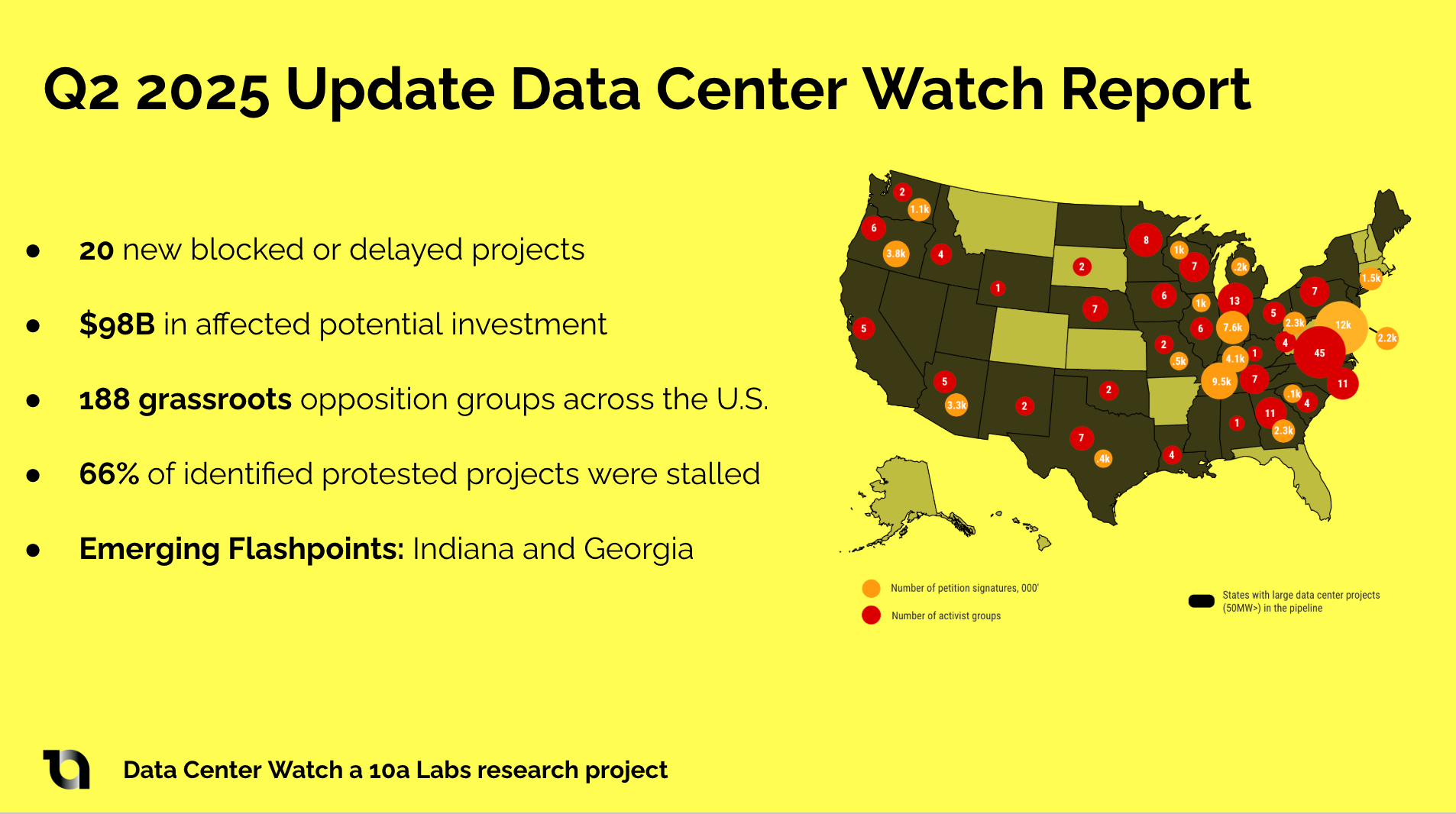
Data Center Watch Report Q2 2025
Check out our Data Center Watch Report for Q2 2025. Opposition to data centers is accelerating nationwide. In Q2 2025 alone, an estimated $98 billion in projects were blocked or delayed, more than the total for all previous quarters since 2023. As political resistance builds and local organizing becomes more coordinated, this is now a sustained and intensifying trend.