Briefing 02/06/2026
Weekly updates on the political risks American data center projects
This week’s round-up: In New York, state lawmakers introduced a bill that would impose a statewide moratorium of more than three years on permits for new data centers. In Michigan, the Mason City Council adopted a new zoning framework for data centers after a contentious public meeting, tightening local rules without formally reflecting a broader shift toward regulatory gatekeeping rather than outright denials. And in Texas, San Marcos’ proposed $1.5 billion data center campus returned to City Council under tougher political conditions after nearby landowners filed a protest petition that raised the rezoning threshold to a supermajority, showing how procedural tools and organized local opposition can materially reshape approval odds even in traditionally pro-development markets. In Washington state, legislators advanced HB 2515, a large-load policy bill that would require utilities to develop formal rules for serving hyperscale data centers.
New York lawmakers introduce a 3-year statewide data center moratorium bill
New York State Sen. Liz Krueger introduced S9144 on February 6, 2026, with co-sponsors Sens. Kristen Gonzalez, Rachel May, and Lea Webb. The bill would place a statewide moratorium of at least three years and 90 days on issuing permits for new data centers. The bill is part of a broader opposition to data centers’ effort focused on energy demand, water use, and utility costs, with supporters arguing the state needs time to assess the scale of new data center load requests.
The proposal states that during the moratorium, no state or local agency, public authority, or public benefit corporation may issue new permits for the siting, construction, or start of operations of a data center.
Reporting from Wired notes that Food & Water Watch has played a role in organizing around the proposal, and that similar calls for moratoria are being advanced in multiple states.
Why it matters:
Regulatory definition risk: Cities without clear “data center” definitions can rapidly pivot to bans once a proposal exposes gaps in the zoning regulation amid local backlash.
Pre-application vulnerability: Even projects that haven’t formally applied can be stalled if councils move first to respond to local opposition.
Kentucky developer sues Simpson County over data center permitting rules
TenKey LandCo sued Simpson County after the county adopted an ordinance requiring new data centers to be in heavy industrial zones and obtain a conditional use permit, with provisions also aimed at related “integrated energy systems.”
The dispute is tied to a proposed $5B data center in Franklin, KY, with the end user still undisclosed publicly. TenKey plans on-site natural gas turbines for that facility.
This case highlights tensions between state-level incentive programs and local land-use authority. It shows how projects can face delays or legal challenges even after incentives are in place, particularly when project details are limited and local officials seek clearer, enforceable conditions.
Why it matters:
Litigation after permitting rulings. Legal action is increasingly being used to resolve permitting disputes when local governments revise zoning rules following public opposition.
The case of Saline City, Michigan, previously covered in our newsletter, suggests a potential precedent for how similar disputes may unfold.
Behind-the-meter generation doesn’t eliminate local opposition. The additional infrastructure needed to be built to provide on-site power generation may introduce additional permitting requirements related to air quality, water use, zoning approvals, and related regulatory oversight.
Mason, MI adopts new data center rules after contentious public meeting
The Mason City Council approved a new zoning framework for data centers on February 3, 2026, following a public meeting where dozens of residents raised concerns about the scale, noise, energy use, and long-term impacts of data center development.
The council’s action did not deny a specific project, but instead established new rules governing if and how data centers can be sited and regulated in the city. City officials framed the vote as a procedural step meant to clarify expectations and give the city more control over future proposals, while residents emphasized the need for stronger safeguards before any projects advance.
The Mason case reflects a broader pattern in Michigan, where municipalities are responding to public concern by tightening zoning and land-use rules rather than voting projects down outright. For the data center industry, this approach can still materially affect feasibility by adding new conditions, extending review timelines, and increasing uncertainty—even in places where there is no formal rejection on the record.
The group Mason Data Center Facts is mobilizing against data center development in the city and has expressed opposition to the moratorium as framed in the M-3/Ordinance 266 framework, advocating for a longer moratorium and stronger restrictions. Mason Data Center Facts says a referendum petition is active to challenge Ordinance 266 (M-3), with a stated deadline of March 2, 2026, and a target of over 1,000 signatures from registered City of Mason voters to put it on the ballot.
Why it matters:
Regulatory tightening is now a default response in places where communities feel surprised by scale or operating impacts.
Michigan continues to mature into a rulemaking battleground, where local ordinance changes can reshape feasibility even without a single “no” vote on a project.
San Marcos, TX faces a renewed $1.5B data center rezoning fight
San Marcos’ proposed $1.5B data center campus (Highlander SM One LLC) is back before the City Council after a prior attempt fell short of the required votes. The current request would reclassify roughly 199.5 acres on the city’s Preferred Scenario Map and rezone the site to allow a large industrial-style data center buildout.
Ahead of the next Council readings, adjacent landowners submitted a protest petition representing at least 20% of the surrounding acreage, which raises the threshold for approval to a six-vote supermajority—making the rezoning materially harder to pass even if a simple majority supports it.
The local group Data Center Action Coalition has been holding public meetings and organizing residents around narratives on water use, noise, and broader environmental impacts in the San Marcos/Hays County area. On the other hand, supporters of the project, such as LIUNA Local 1095 and other labor advocates, have emphasized union construction jobs and longer-term workforce development, while city staff have highlighted proposed operating constraints (including a closed-loop cooling approach) and the city’s budget pressures as part of the policy context.
Procedural tools (like protest petitions) can materially change the approval math, even when projects appear administratively viable.
Local fiscal stress can cut both ways: budget pressures may motivate support, but they can also intensify scrutiny around “who benefits.”
Washington state lawmakers move to shift grid costs onto data centers
Washington lawmakers advanced legislation aimed at ensuring large new data centers bear more of the electric system costs associated with their growth. The main proposal, HB 2515, introduced by state Rep. Beth Doglio (D), would require electric utilities to develop formal policies for serving “emerging large energy use facilities,” a category that includes hyperscale data centers. The bill is framed around concerns that rapid load growth from data centers could raise electricity costs for other customers if not explicitly managed through new rules and cost-allocation mechanisms.
Support for shifting costs has been driven by environmental and consumer-focused groups, including Columbia Riverkeeper, which has publicly called for stronger regulation of data centers’ energy impacts and protections for ratepayers. These groups argue that utilities and regulators need clearer authority to prevent grid upgrades for large loads from being socialized across residential and small-business customers.
Utility cost allocation is moving from wonky dockets into mainstream politics, increasing the chance of statutory changes that affect project economics.
Legislative uncertainty can slow siting decisions as operators evaluate exposure to new tariffs, special contracts, or large-load rules
Mentions in the Press
“The tech industry is spending millions to fix data centers’ image problem”
https://www.fastcompany.com/91485390/tech-industry-is-spending-millions-to-fix-data-centers-image-problem
“The Local Costs of the AI Boom: Ensuring Data Centers Deliver Community Benefits In The Midst of Hypergrowth”
https://ncrc.org/the-local-costs-of-the-ai-boom-ensuring-data-centers-deliver-community-benefits-in-the-midst-of-hypergrowth/
“Data center moratoriums pile up in Michigan. No one knows if they’ll work”
https://bridgemi.com/michigan-environment-watch/at-least-19-michigan-towns-pause-data-centers-no-one-knows-if-itll-work/
“Malaysia Draws First Data Center Protest Over Pollution, Water”
https://www.bloomberg.com/news/articles/2026-02-07/malaysia-draws-first-data-center-protest-over-pollution-water
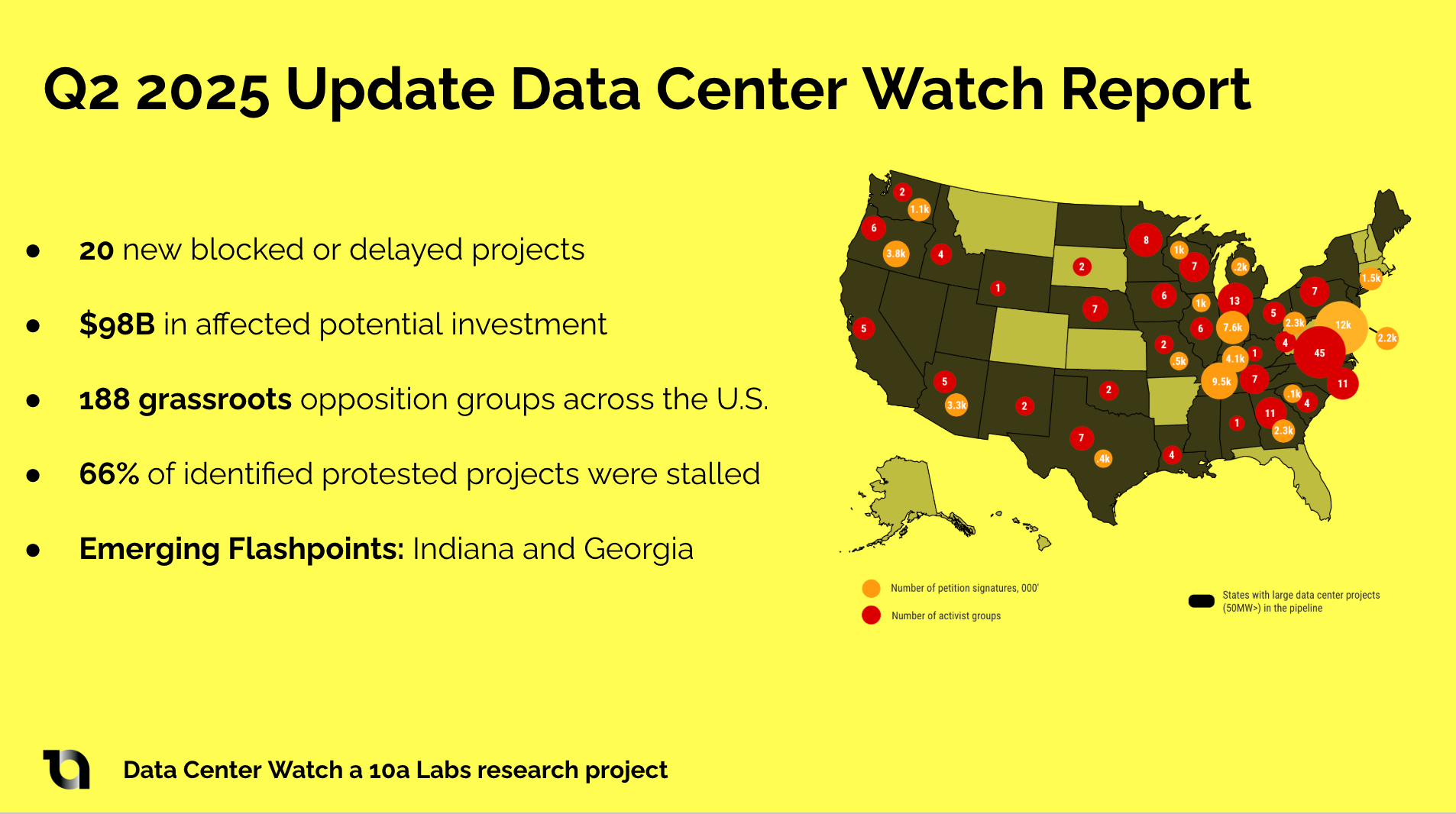
Data Center Watch Report Q2 2025
Check out our Data Center Watch Report for Q2 2025. Opposition to data centers is accelerating nationwide. In Q2 2025 alone, an estimated $98 billion in projects were blocked or delayed, more than the total for all previous quarters since 2023. As political resistance builds and local organizing becomes more coordinated, this is now a sustained and intensifying trend.