Briefing 01/30/2026
Weekly updates on the political risks American data center projects
This week’s round-up: In New Orleans, Louisiana, the City Council advanced a one-year moratorium on data centers, crypto mining facilities, and server farms after neighborhood opposition to a proposed project. In Simpson County, Kentucky, developer TenKey LandCo sued the county over new zoning and conditional-use requirements tied to a proposed $5 billion data center, highlighting how projects can face delays or litigation even in incentive-friendly states. In Fayetteville, Georgia, the Planning & Zoning Commission denied rezoning and issued an advisory rejection of a conceptual data center plan. And in Huron County, Michigan, commissioners discussed a potential moratorium amid early signs of developer interest, even before a specific project or end user has been identified.
New Orleans City Council moves toward a one-year ban on data centers
The New Orleans City Council advanced a one-year moratorium on data centers, crypto mining facilities, and server farms while the city works on zoning definitions and permanent rules. The action followed neighborhood pushback tied to a proposed facility associated with MS Solar Grid Data in New Orleans East (Little Woods area). Mayor Helena Moreno publicly opposed the project.
We can observe a “rules-first” trend taking hold, with local governments choosing temporary bans to buy time, especially when residents argue that water and power impacts aren’t being priced or regulated accurately.
Why it matters:
Regulatory definition risk: Cities without clear “data center” definitions can rapidly pivot to bans once a proposal exposes gaps in the zoning regulation amid local backlash.
Pre-application vulnerability: Even projects that haven’t formally applied can be stalled if councils move first to respond to local opposition.
Kentucky developer sues Simpson County over data center permitting rules
TenKey LandCo sued Simpson County after the county adopted an ordinance requiring new data centers to be in heavy industrial zones and obtain a conditional use permit, with provisions also aimed at related “integrated energy systems.”
The dispute is tied to a proposed $5B data center in Franklin, KY, with the end user still undisclosed publicly. TenKey plans on-site natural gas turbines for that facility.
This case highlights tensions between state-level incentive programs and local land-use authority. It shows how projects can face delays or legal challenges even after incentives are in place, particularly when project details are limited and local officials seek clearer, enforceable conditions.
Why it matters:
Litigation after permitting rulings. Legal action is increasingly being used to resolve permitting disputes when local governments revise zoning rules following public opposition.
The case of Saline City, Michigan, previously covered in our newsletter, suggests a potential precedent for how similar disputes may unfold.
Behind-the-meter generation doesn’t eliminate local opposition. The additional infrastructure needed to be built to provide on-site power generation may introduce additional permitting requirements related to air quality, water use, zoning approvals, and related regulatory oversight.
Fayetteville, Georgia, planning commission denies data-center-linked requests
Fayetteville’s Planning & Zoning Commission took two actions related to proposed data center development along Highway 85 North. The commission denied a request by Corvus Investment Group to rezone an annexed property to Business Park (BP) and instead recommended Light Industrial zoning, which does not allow data centers by right. The commission also voted to deny a conceptual data center plan submitted by CHI/Acquisitions, LP for a separate site already zoned BP; this vote was advisory and may be appealed to the City Council. Public comment at the meeting was largely opposed to the proposals.
The actions reflect a broader trend in the metro Atlanta area, where local boards are revisiting zoning frameworks that allow data centers as permitted uses, particularly in areas near residential or mixed-use development.
Why it matters:
Zoning focus shifts upstream: Zoning classifications are increasingly a focal point in data center debates, with communities focusing on whether facilities should be allowed as a permitted use rather than on individual project approvals.
Advisory votes signal risk: Even nonbinding or advisory votes can affect project timelines by signaling potential concerns at the City Council level and increasing the likelihood of additional conditions or delays.
Huron County, Michigan, weighs a possible data center moratorium
At a January 27 meeting, officials in Huron County discussed potential data center development and raised the possibility of a temporary moratorium. Commissioners and public speakers cited concerns about electricity availability, groundwater and aquifer use, and consistency with the county’s rural master plan. No formal action was taken, but several commissioners indicated interest in pausing to further study potential impacts.
Local officials are increasingly treating data centers as a distinct land-use category that may require additional review, even before a specific developer or end user is publicly identified.
Why it matters:
Early-stage moratorium risk: Rural counties are considering preemptive moratoria as soon as officials believe data center developers may be exploring sites.
Resource constraints shape narratives: Concerns about both electricity capacity and water availability are increasingly raised together, strengthening the case for heightened scrutiny or delays.
Mentions in the Press
“Data centers are facing an image problem — the tech industry is spending millions to rebrand them”
https://grist.org/energy/data-centers-are-facing-an-image-problem-the-tech-industry-is-spending-millions-to-rebrand-them/
“Trump-era data center boom could leave consumers footing the bill”
https://thehill.com/policy/technology/5711639-trump-data-centers-consumer-impact/
“Data center opposition gains momentum as power demand spikes”
https://www.spglobal.com/energy/en/news-research/latest-news/electric-power/012926-data-center-opposition-gains-momentum-as-power-demand-spikes
“Are creative power deals actually speeding up development?”
https://www.latitudemedia.com/news/are-creative-power-deals-actually-speeding-up-development/
“AmberSemi launches PowerTile to cut data center power drain”
https://www.datacenterknowledge.com/build-design/ambersemi-launches-powertile-to-cut-data-center-power-drain
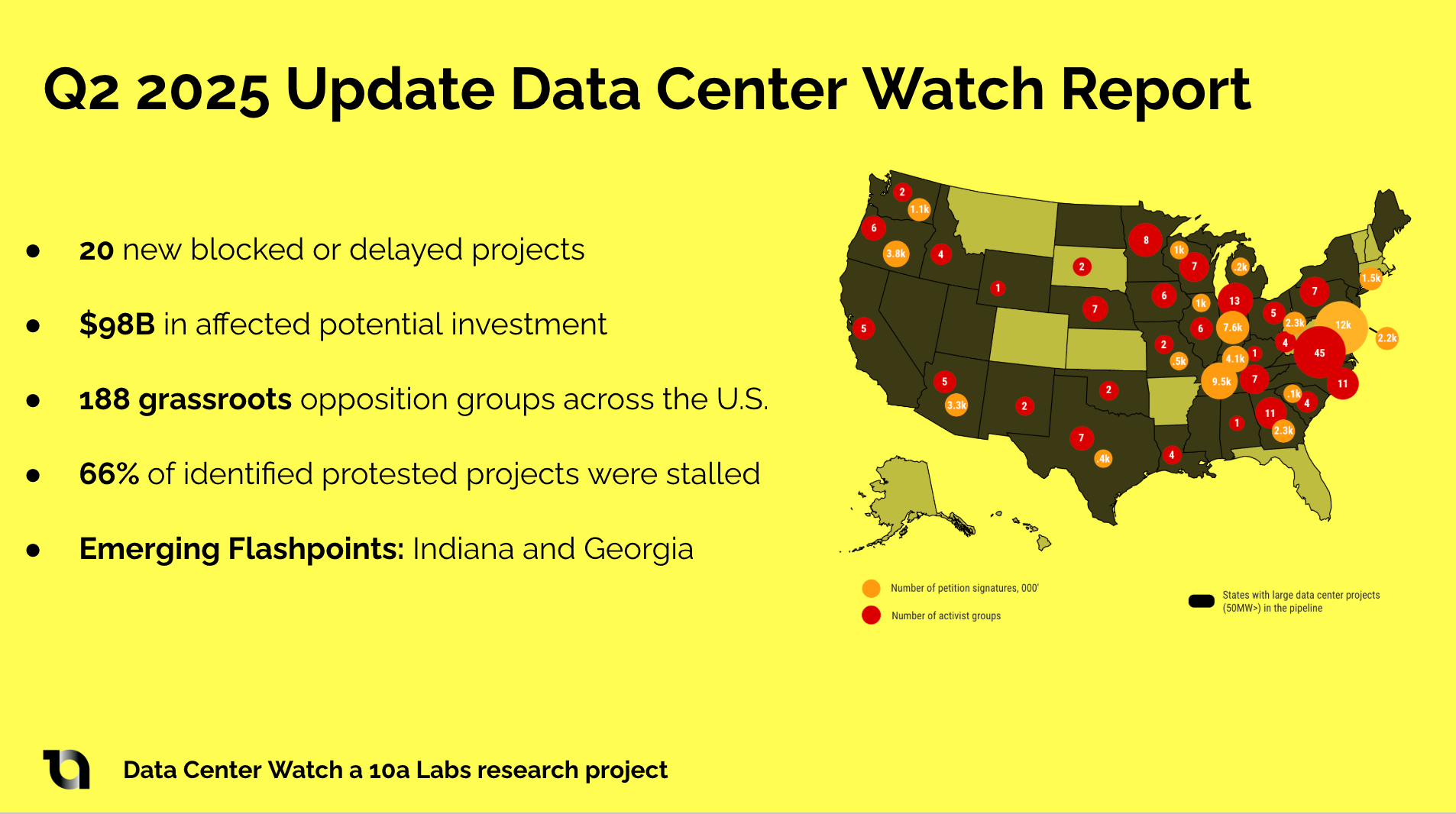
Data Center Watch Report Q2 2025
Check out our Data Center Watch Report for Q2 2025. Opposition to data centers is accelerating nationwide. In Q2 2025 alone, an estimated $98 billion in projects were blocked or delayed, more than the total for all previous quarters since 2023. As political resistance builds and local organizing becomes more coordinated, this is now a sustained and intensifying trend.