
Briefing 01/16/2026
Weekly updates on the political risks American data center projects
This week’s round-up: In Michigan, the Saline City Council unanimously adopted a one-year moratorium on new data center approvals, arguing the city’s zoning code does not yet define or regulate data centers and citing 2025 inquiries from Fortune 100 companies interested in building on nearby large parcels. In Wayne County, residents in Van Buren Township organized a protest against Panattoni’s “Project Cannoli,” a proposed 1GW data center. And at the national level, Microsoft President Brad Smith rolled out a five-point “community commitments” framework as a bid to reduce local opposition and to set a more durable playbook for approval of large-scale projects.
Saline Township enacts a temporary moratorium on data centers
Saline’s City Council unanimously approved a one-year moratorium on data centers, saying the city’s zoning ordinance doesn’t currently address data centers as a specific use. Community Development Director Chris Atkin said the city is mirroring steps taken by other Michigan communities. The resolution was moved by Councilor Jenn Harmount and seconded by Councilor Nicole Rice, with Mayor Brian Marl backing the pause as a “pragmatic” way to build a regulatory framework—especially after the city received inquiries in 2025 from Fortune 100 companies interested in developing nearby large parcels and potentially seeking annexation and access to Saline utilities.
This looks like an early-warning signal: even in places that say they don’t have parcels big enough for a hyperscale facility, local governments are moving to prevent being “surprised” by an application (or an annexation play) before they have tailored standards in place.
Why it matters:
Moratoriums as a “rules-first” approach: Cities that do not yet have data-center-specific zoning rules are adopting temporary moratoriums to give themselves time to write them. That can delay projects and add timeline uncertainty even when no application has been filed.
Annexation and utility access as a key issue: Saline’s concern is not only about data centers inside the city, but also about projects proposed just outside city limits that could seek annexation in order to use city utilities. Local governments may respond by adding new requirements or restrictions around that pathway.
Residents of Van Buren Township oppose a 1GW data center
Residents in Van Buren Township (Wayne County, MI) planned a demonstration ahead of a planning commission meeting to oppose “Project Cannoli,” a proposed 1 GW data center. Organizers say public outreach has been inadequate and warn the project could increase utility rates.
A petition opposing the project had over 1,300 signatures, citing concerns about reliability and electricity bills. The developer, Panattoni Development Co., is expected to present its case before the planning commission on February 11.
Van Buren Township fits a broader pattern playing out across Michigan: once a large-load data center proposal becomes public, it often triggers organized resident mobilization — petitions, demonstrations, and calls for stricter siting and utility safeguards — well before the decisive planning and zoning votes. That early organizing can increase entitlement and timeline risk, and it tends to widen the dispute beyond land use into broader issues.
Why it matters:
Water and utility rates: Township documents estimate the project could use 2 to 3.6 million gallons of water per day for cooling. Because the water would be purchased through the township and supplied via Great Lakes Water Authority connections, core project “inputs” — water supply, electricity capacity, and backup generation — are becoming the central issues in the local permitting debate.
Changing landscape of Michigan’s large-load policy environment: Michigan is trying to attract hyperscale data centers with a sales and use tax exemption, while bipartisan lawmakers are simultaneously pushing to repeal or revise it. That push-pull creates uncertainty for developers and investors trying to model project economics, incentive durability, and entitlement timelines.
Microsoft says its data centers won’t burden the locals
Microsoft President Brad Smith announced a five-point set of commitments aimed at addressing local concerns about new data centers. Microsoft says it will: (1) pay electricity rates high enough to cover both new infrastructure and ongoing utility operations (2) minimize water use and replenish more water than it consumes; (3) support local job access by training residents for operations roles; (4) not seek or accept property-tax reductions; and (5) invest in local AI training and nonprofits. Axios notes these pledges come as community opposition rises in multiple markets over utility bills, water use, and limited long-term job creation.
Why it matters:
“Pay-your-way” is becoming a de facto standard for winning approvals. Microsoft is explicitly tying acceptance to cost-allocation: higher rates, clearer cost responsibility, and fewer tax concessions—signals that utilities, regulators, and municipalities may increasingly expect large-load projects to internalize grid and resource costs.
Trying to set an industry standard. Microsoft is positioning its commitments as a template for addressing the most common local objections—utility costs, water impacts, and limited jobs—at a moment when data center permitting risk is increasingly shaped by public sentiment and ratepayer politics, not just zoning.
Mentions in the Press
The crosswinds of AI, sustainability, and human rights enter the mainstream in 2026
https://www.thomsonreuters.com/en-us/posts/sustainability/human-rights-enter-the-mainstream/
Trump seeks to quell rebellion over data centers
https://www.washingtonpost.com/technology/2026/01/13/trump-microsoft-data-centers-opposition/
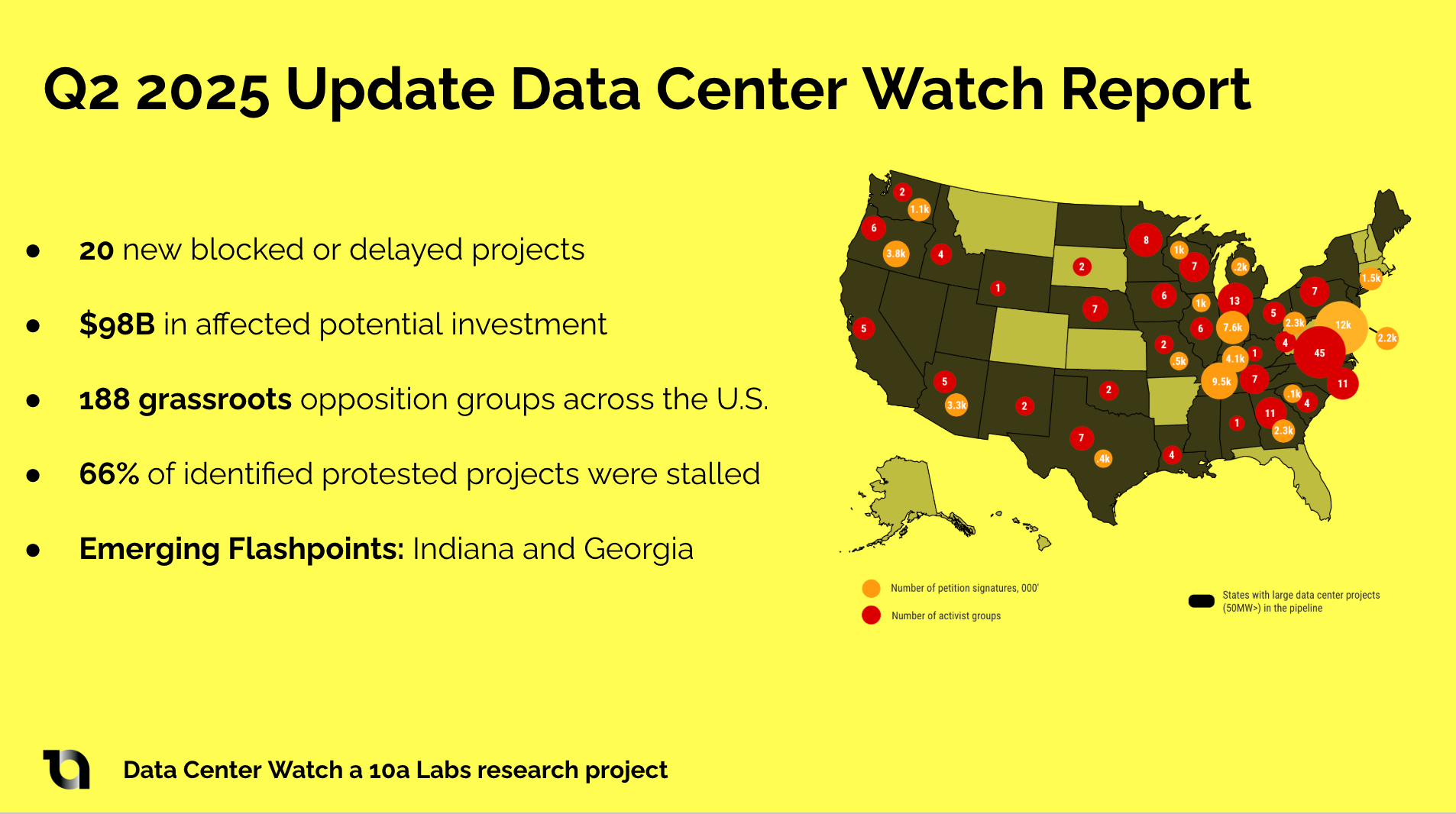
Data Center Watch Report Q2 2025
Check out our Data Center Watch Report for Q2 2025. Opposition to data centers is accelerating nationwide. In Q2 2025 alone, an estimated $98 billion in projects were blocked or delayed, more than the total for all previous quarters since 2023. As political resistance builds and local organizing becomes more coordinated, this is now a sustained and intensifying trend.
Incredibly thorough coverage tbh. The Saline moratorium piece really captures how these "pause and regulate" moves are becoming the default when municipalities realize their zoning codes haven't caught up to hyperscale infrastructure. What's fasinating is the annexation angle, where cities are proactivly blocking future utility access plays rather than just site approvals. In my experiance watching local planning boards, these moratoriums end up lasting way longer than intended once residents organize around water usage concerns.